

Sizing Up Toyota’s Two Three-Row SUVs
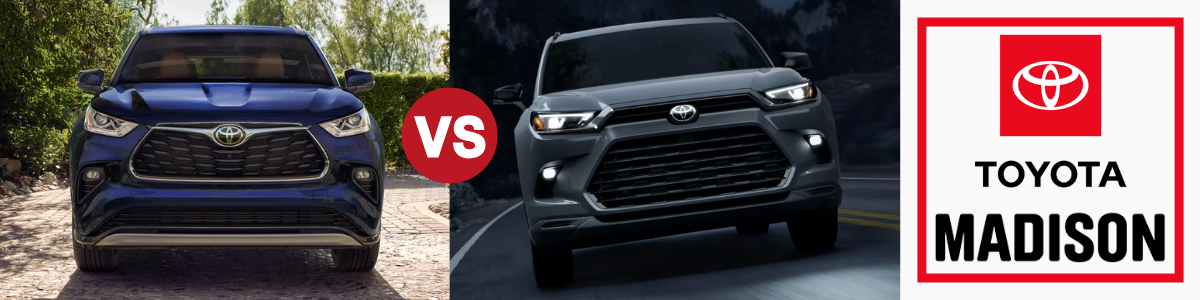
Toyota sells two three-row SUVs with almost the same name, and that trips up a lot of shoppers. Both share a badge, a turbocharged four-cylinder, and the same family-hauling job description. What separates them is about six inches of sheet metal and a third row that changes the math for anyone who uses it more than twice a year.
- The Grand Highlander stretches 201.4 inches long on a 116.1-inch wheelbase, while most Highlander grades measure 194.9 inches on a 112.2-inch wheelbase.
- Both SUVs share a 265-horsepower turbocharged 2.4-liter gas engine, but only the Grand Highlander offers the 362-horsepower Hybrid MAX setup.
- Pricing starts at $41,860 for the gas Grand Highlander LE and $45,870 for the gas Highlander XLE, both before the $1,495 destination charge.
Where Those Extra Inches Actually Land
Park these two next to each other, and the gap looks smaller than the spec sheet suggests. Toyota puts most of the added length behind the second row. That’s exactly where families feel it. Cargo room behind the Grand Highlander’s third row measures 20.6 cubic feet. Fold the second and third rows down, and it opens up to 97.5 cubic feet. Toyota lists the Highlander’s max at 84.3 cubic feet with every seat folded, but hasn’t published a behind-the-second-row number for 2026. Don’t assume the two are close there.
Width and height tell part of the story, too. Grand Highlander stands 70.1 inches tall and 78.3 inches wide, against 68.1 by 76.0 for the Highlander. That boxier shape is what third-row riders notice around their shoulders and heads.
Two Engine Menus, One With an Extra Course
Under the hood, things start out identical. Each SUV runs a 2.4-liter turbo four rated at 265 horsepower and 310 lb-ft of torque, paired with an eight-speed automatic. From there, the lineups split. Every 2026 Highlander gas grade arrives with all-wheel drive standard. The larger SUV begins as a front-driver on LE, XLE, and Limited. AWD adds $1,600 on those grades and comes standard on the gas Platinum.
Hybrids follow a similar pattern. Highlander’s 2.5-liter hybrid makes 243 combined horsepower with electronic on-demand AWD on every grade. The EPA rates it at 35 mpg combined. Step over to the Grand Highlander, and its 2.5-liter hybrid makes 245 combined horsepower, good for 34 mpg combined in AWD LE and Limited form. Then there’s the powertrain Highlander can’t answer. Hybrid MAX pairs a turbocharged 2.4-liter with front and rear electric motors for 362 combined horsepower and 400 lb-ft. It runs a six-speed automatic and still posts 27 mpg combined.
Towing and Trailer Math
Gas grades of either SUV pull 5,000 pounds with the required equipment. Pick a standard hybrid, and both fall to 3,500 pounds. Hybrid MAX climbs back to 5,000 pounds. That makes the Grand Highlander your only path to a Toyota hybrid three-row rated for the full 5,000 pounds. Anyone towing a small camper or a pair of jet skis should sit with that number for a while.
Safety Tech and Screens Take Different Paths
Highlander carries Toyota Safety Sense 2.5+. Grand Highlander steps up to Toyota Safety Sense 3.0. That version adds Proactive Driving Assist, which applies gentle braking and light steering to help around cyclists, walkers, and slower traffic. Blind Spot Monitor with Rear Cross-Traffic Alert is standard on every grade of both SUVs. Screens differ as well. Highlander starts with an 8-inch touchscreen and offers a 12.3-inch upgrade. The 12.3-inch display comes standard across the entire Grand Highlander lineup.

2026 Highlander and Grand Highlander Trim Comparison Chart
| Trim | Powertrain | Horsepower | Drivetrain | EPA MPG City/Hwy | Starting MSRP |
|---|---|---|---|---|---|
| 2026 TOYOTA HIGHLANDER | |||||
| XLE | 2.4L Turbo Gas, 8-Speed Auto | 265 hp / 310 lb-ft | Mechanical AWD | 21 / 28 | $46,270 |
| XSE | 2.4L Turbo Gas, 8-Speed Auto | 265 hp / 310 lb-ft | Torque Vectoring AWD | 21 / 28 | $48,340 |
| Limited | 2.4L Turbo Gas, 8-Speed Auto | 265 hp / 310 lb-ft | Torque Vectoring AWD | 21 / 28 | $50,725 |
| Platinum | 2.4L Turbo Gas, 8-Speed Auto | 265 hp / 310 lb-ft | Torque Vectoring AWD | 21 / 28 | $53,925 |
| Hybrid XLE | 2.5L Hybrid, eCVT | 243 hp combined | Electronic On-Demand AWD | 35 / 35 | $48,020 |
| Hybrid Limited | 2.5L Hybrid, eCVT | 243 hp combined | Electronic On-Demand AWD | 35 / 34 | $52,475 |
| Hybrid Platinum | 2.5L Hybrid, eCVT | 243 hp combined | Electronic On-Demand AWD | 35 / 34 | $55,675 |
| 2026 TOYOTA GRAND HIGHLANDER | |||||
| LE | 2.4L Turbo Gas, 8-Speed Auto | 265 hp / 310 lb-ft | FWD, AWD +$1,600 | 21 / 28 (FWD) | $42,060 |
| XLE | 2.4L Turbo Gas, 8-Speed Auto | 265 hp / 310 lb-ft | FWD, AWD +$1,600 | 21 / 28 (FWD) | $44,830 |
| Limited | 2.4L Turbo Gas, 8-Speed Auto | 265 hp / 310 lb-ft | FWD, AWD +$1,600 | 21 / 28 (FWD) | $49,560 |
| Platinum | 2.4L Turbo Gas, 8-Speed Auto | 265 hp / 310 lb-ft | AWD standard | 20 / 26 | $55,245 |
| Hybrid LE | 2.5L Hybrid, eCVT | 245 hp combined | FWD or Electronic On-Demand AWD | 36 / 32 | $45,410 |
| Hybrid XLE | 2.5L Hybrid, eCVT | 245 hp combined | FWD or Electronic On-Demand AWD | 37 / 34 | $46,580 |
| Hybrid Limited | 2.5L Hybrid, eCVT | 245 hp combined | Electronic On-Demand AWD | 36 / 32 | $52,910 |
| Hybrid Nightshade | 2.5L Hybrid, eCVT | 245 hp combined | Electronic On-Demand AWD | 36 / 32 | $53,890 |
| Hybrid MAX Limited | 2.4L Turbo Hybrid MAX, 6-Speed Auto | 362 hp / 400 lb-ft combined | Full-Time Electronic AWD | 26 / 27 | $55,890 |
| Hybrid MAX Platinum | 2.4L Turbo Hybrid MAX, 6-Speed Auto | 362 hp / 400 lb-ft combined | Full-Time Electronic AWD | 26 / 27 | $59,975 |
| All MSRP figures exclude the $1,495 delivery, processing, and handling charge. Highlander towing tops out at 5,000 lb on gas grades and 3,500 lb on hybrid grades. Grand Highlander towing tops out at 5,000 lb on gas and Hybrid MAX grades and 3,500 lb on standard hybrid grades. EPA estimates are for comparison only, and your mileage will vary. | |||||
The Highlander That Fits Most Driveways
Anyone weighing the 2026 Toyota Highlander vs. Grand Highlander is really asking one question. How often does row three carry passengers? If the answer is holiday weekends and carpool overflow, Highlander handles it, costs less on the hybrid side, and slots into a tight garage without drama. If your third row has a regular passenger, or if groceries and sports bags pile up behind it every week, the 20.6 cubic feet and the Hybrid MAX option make the Grand Highlander worth the stretch. Toyota built these two for different kinds of weeks, and both do their job well.
Why Buy Your Next Highlander at Toyota of Madison
Numbers on a page can only take you so far with a decision like this. We keep both the Highlander and Grand Highlander on the lot so you can climb into the third row of each, fold the seats, and load your own stroller or hockey bag before you sign anything. Our team will walk you through gas versus hybrid versus Hybrid MAX in plain terms, no jargon and no pressure. Bring the whole family and the car seats, and we’ll help you sort out which one fits your week in Madison and the surrounding area.

How the 2026 Camry and Accord Match Up for Daily Drivers
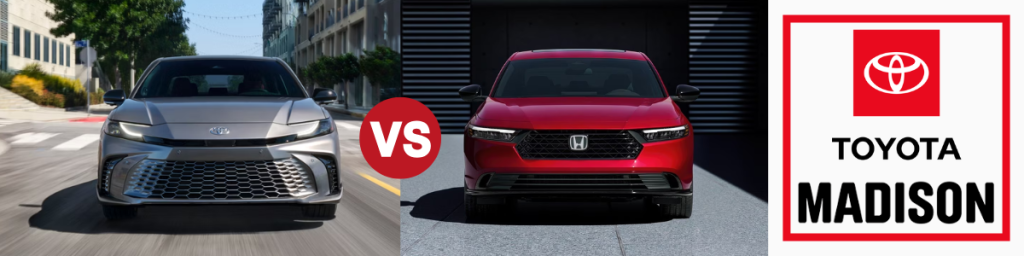
America’s two best-selling sedans have traded punches for decades, and 2026 keeps the rivalry going strong. Toyota went all-in on hybrid power for every Camry this year, while Honda still sells a gas Accord and saves its hybrid setup for the upper trims. Both seat five, both sip fuel, and both have loyal fans who swear by their pick. So which one belongs in your driveway?
- Every 2026 Camry comes as a hybrid, starting at $29,300 and rated up to 51 mpg combined on the LE grade.
- Honda’s 2026 Accord starts lower at $28,395 with a turbo gas engine, and its hybrid trims reach up to 48 mpg combined.
- Toyota offers all-wheel drive on every Camry trim, while the Accord stays front-wheel drive across the whole lineup.
What’s Under the Hood
This is where the two cars split in a big way. Every 2026 Camry runs a 2.5L four-cylinder hybrid paired with an eCVT. Front-drive models make 225 horsepower combined, and the available all-wheel-drive setup bumps that to 232. You get the same hybrid no matter which Camry you choose.
Honda plays it differently. Base LX and SE trims use a 1.5L turbocharged four-cylinder good for 192 horsepower and 192 lb-ft of torque, with a CVT. Want the hybrid? You’ll step up to the Sport Hybrid or higher, which runs a 2.0L two-motor system rated at 204 horsepower and a strong 247 lb-ft of torque. That tradeoff sits at the heart of the 2026 Toyota Camry vs. Honda Accord question. Toyota gives you hybrid power from the jump, and Honda lets you start cheaper on gas before paying up for electrification.
Fuel Economy by the Numbers
Toyota’s all-hybrid plan pays off at the pump. In front-drive form, the Camry LE earns an EPA-estimated 52 city, 49 highway, and 51 combined. Sportier SE, XLE, and XSE trims land around 47/45/46. Adding AWD trims those numbers a touch.
Honda’s gas Accord LX returns 29 city, 37 highway, and 32 combined, with the SE close behind at 28/36/31. Move to the hybrids, and the gap shrinks fast. Most Accord hybrids hit 46/41/44, and the EX-L Hybrid is the mileage champ of the bunch at 51/44/48. Camry still edges ahead on combined numbers, but a hybrid Accord is no slouch.
Trim-by-Trim Breakdown
| Trim | Powertrain | Horsepower | Combined MPG | Starting MSRP |
|---|---|---|---|---|
| 2026 Toyota Camry (Hybrid, FWD or AWD) | ||||
| LE | 2.5L Hybrid | 225 hp (FWD) | 51 | $29,300 |
| SE | 2.5L Hybrid | 225 hp (FWD) | 46 | $31,800 |
| Nightshade | 2.5L Hybrid | 225 hp (FWD) | 46 | $32,800 |
| XLE | 2.5L Hybrid | 225 hp (FWD) | 46 | $34,500 |
| XSE | 2.5L Hybrid | 225 hp (FWD) | 46 | $35,700 |
| 2026 Honda Accord (Gas or Hybrid, FWD only) | ||||
| LX | 1.5L Turbo Gas | 192 hp | 32 | $28,395 |
| SE | 1.5L Turbo Gas | 192 hp | 31 | $30,695 |
| Sport Hybrid | 2.0L Hybrid | 204 hp | 44 | $33,795 |
| EX-L Hybrid | 2.0L Hybrid | 204 hp | 48 | $35,095 |
| Sport-L Hybrid | 2.0L Hybrid | 204 hp | 44 | $35,495 |
| Touring Hybrid | 2.0L Hybrid | 204 hp | 44 | $39,495 |
Prices exclude the $1,195 destination charge on both cars. Camry AWD adds $1,525 to any trim.
Tech and Cabin Touches
Both sedans load up on screens. Camry runs an 8-inch touchscreen on the LE, SE, and Nightshade, then jumps to a 12.3-inch display on the XLE and XSE. Wireless Apple CarPlay and Android Auto come standard on every trim, and so does blind spot monitoring with rear cross-traffic alert. Move up the ladder, and you can add a JBL audio system, a head-up display, and a panoramic roof.
Accord answers with a 9-inch screen on the LX and SE and a 12.3-inch unit on the hybrids, plus a 10.2-inch digital gauge cluster on all trims. Honda keeps a physical volume knob, which many drivers appreciate. Up top, the Touring Hybrid piles on Google built-in, a 12-speaker Bose system, a heated steering wheel, and ventilated front seats. Worth flagging too, blind spot info is standard on the SE and up, but not on the base LX.

Picking the Sedan That Fits Your Week
If you want the best gas mileage for the least money, plus the option of all-wheel drive for snowy mornings, the Camry makes the easy case. Every trim is a hybrid, so you never have to choose between saving fuel and saving cash. Drivers who want a lower entry price on gas, a sportier steering feel, or a fully loaded tech flagship like the Touring will lean toward Honda. Both are dependable picks that hold their worth well, so a test drive in each is the smartest way to settle it.
See the 2026 Camry at Toyota of Madison
At Toyota of Madison, we make it simple to put the 2026 Camry to the test in person. Reading specs is one thing, but feeling how the hybrid pulls away from a stop and checking whether that 12.3-inch screen suits you is another. We keep a wide selection of new Camry trims on the lot, and our team is glad to walk you through each one at your own pace. Stop by when you’re ready to compare them side by side, take a drive around Madison, and find the trim that fits how you actually drive.

Sizing Up Two Family Minivan Heavyweights for 2026
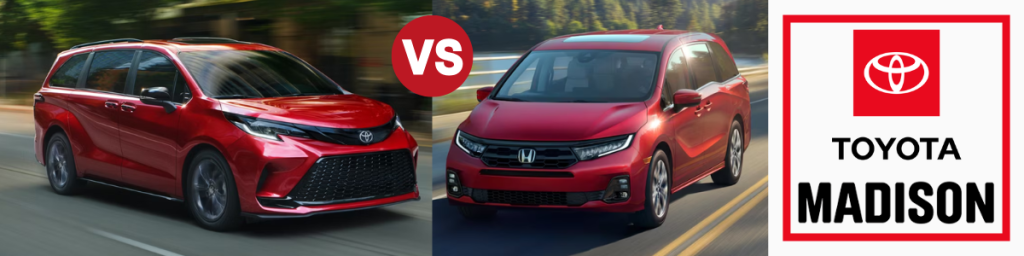
Minivans don’t sell on flash. They sell on what happens after the kids are buckled in, the groceries are loaded, and the dog has muddied up the third row again. For 2026, the segment’s two best-known nameplates take very different approaches to that daily grind. Toyota leans into hybrid efficiency. Honda sticks with V6 muscle. That contrast is where most family driveway decisions get made.
- Toyota’s 2026 Sienna pairs a hybrid powertrain with available all-wheel drive across most trims.
- Honda’s 2026 Odyssey sticks with a 280-horsepower V6 and front-wheel drive only.
- Choosing between them often comes down to fuel economy against cargo capacity and seating layout.
Two Different Approaches Under the Hood
When it comes to the Sienna vs. Odyssey, Toyota built the 2026 Sienna around a 2.5-liter four-cylinder hybrid system that produces 245 net horsepower combined. It pairs with an electronic continuously variable transmission, and a separate rear electric motor adds available all-wheel drive on most trims. Honda takes a different path. Every 2026 Odyssey runs a 3.5-liter V6 making 280 horsepower and 262 lb-ft of torque, mated to a 10-speed automatic. Front-wheel drive is your only choice with the Odyssey.
Off the line, that V6 and 10-speed combo gives the Odyssey a noticeable edge in passing power. Sienna feels quiet and smooth at city speeds, and its hybrid setup pulls confidently when you need to merge.
Fuel Economy at the Pump
Hybrid wins here, and it isn’t close. EPA-rated at 36 mpg combined for front-drive Sienna models and 35 mpg combined with all-wheel drive, the Toyota leaves the Odyssey far behind. Honda’s V6 returns 19 city, 28 highway, and 22 combined. Run the math on a 15,000-mile driving year at $3.50 per gallon, and Sienna can save you north of $900 a year on gas. That’s real money. Stretch it across five or six years of ownership, and you’re looking at thousands.
Seating, Sliding Doors, and Daily Comfort
Both minivans seat up to eight passengers. Sienna also offers a seven-seat layout with second-row captain’s chairs, depending on trim, which works well for families who want easy walk-through access to the third row. Honda’s Magic Slide second-row seats move side to side and fold flat for hauling longer cargo. Sienna trims at XLE and above come with four-zone automatic climate control, while Honda now equips every trim with leather-trimmed seats. Each van comes with dual power sliding doors and a power tailgate as standard kit.

Cargo Room for Real Life
Honda gets the win on raw hauling capacity. The 2026 Odyssey offers 38.6 cubic feet behind the third row, 91.0 cubic feet behind the second row, and a cavernous 155.8 cubic feet with seats stowed. Sienna counters with 33.5 cubic feet behind the third row, 75.2 cubic feet behind the second row, and 101.0 cubic feet total. Either van will swallow a Costco run or a stack of soccer gear without complaint, but families packing for cross-country trips might appreciate Odyssey’s deeper hold.
2026 Trim Levels at a Glance
| 2026 Toyota Sienna vs. Honda Odyssey Trim Comparison | ||
|---|---|---|
| Tier | Toyota Sienna | Honda Odyssey |
| Entry | LE Starting at $40,820 245 hp hybrid, 36 mpg combined (FWD), 8-inch touchscreen, Toyota Safety Sense 2.0, dual power sliding doors |
EX-L Starting at $42,795 280 hp V6, 22 mpg combined, 9-inch touchscreen, Magic Slide seats, Honda Sensing, leather-trimmed seats |
| Mid | XLE Starting at $45,520 12.3-inch touchscreen, four-zone climate, available AWD, available moonroof, available rear entertainment |
Sport-L Starting at $43,895 19-inch wheels, sport styling cues, parking sensors, exclusive interior trim |
| Sport / Upper | XSE Starting at $48,745 Sport-tuned suspension, 20-inch wheels (FWD), JBL premium audio, leather sport seats |
Touring Starting at $47,495 Built-in navigation, CabinWatch and CabinTalk, Wi-Fi hotspot, rear-seat entertainment, rear sunshades |
| Luxury | Limited Starting at $51,505 Heated and ventilated leather front seats, 12.3-inch digital cluster, available 1500W outlet |
Elite Starting at $51,695 11-speaker 500W audio, heated steering wheel, heated and ventilated front seats, hands-free tailgate, rain-sensing wipers |
| Top | Platinum Starting at $58,210 AWD standard, 10-inch head-up display, FridgeBox, integrated vacuum, panoramic camera, heated second-row captain’s chairs |
No higher trim. Elite tops the Odyssey lineup. |
| Off-Road | Woodland Edition Starting at $51,600 AWD standard, added ground clearance, 1500W outlet, tow hitch with 3,500-lb capability |
Not offered. |
| MSRP figures shown exclude destination. Sienna destination is $1,595; Odyssey destination is $1,495. Pricing accurate at the time of writing; verify with the dealer. | ||
Tech and Safety You’ll Use Daily
Both vans come standard with strong driver-assist suites. Toyota Safety Sense 2.0 covers pre-collision braking with pedestrian detection, lane departure alert with steering assist, adaptive cruise control, and lane tracing on every Sienna. Honda Sensing matches it with collision mitigation braking, road departure mitigation, adaptive cruise with low-speed follow, and lane keep assist. Sienna trims XLE and up get a 12.3-inch touchscreen, while every Odyssey now ships with a 9-inch touchscreen plus wireless Apple CarPlay and Android Auto. Both setups support wireless phone charging.
Where the Sienna vs. Odyssey Decision Lands
For families who rack up highway miles or live where snow shows up half the year, Sienna’s hybrid efficiency and available all-wheel drive are tough to beat. For families who want eight-passenger seating across every trim, a V6 with strong passing power, and more cargo room behind the second row, Odyssey makes a strong case. Both are excellent family haulers. Your daily driving habits should make the call, along with how much winter weather you face.
Test Drive the 2026 Sienna at Toyota of Madison
Families across Madison, Bedford, Seymour, and Louisville have been part of our community for over a century, and Sienna sits high on our list for parents who want strong fuel economy without giving up room for car seats, soccer gear, and the occasional Home Depot run. Stop by our showroom to climb into Sienna’s roomy cabin, sit behind the wheel, and feel how the hybrid drivetrain handles on local roads. Our Toyota-trained team can walk you through trim-by-trim differences, help you weigh hybrid versus V6 ownership costs over time, and answer any questions about ToyotaCare maintenance coverage. Drop in whenever you’re ready to take one out for a spin.
Toyota Puts Power to All Four Wheels Across Nearly Every 2026 Model
If you’ve been shopping for a new Toyota and wondering about all wheel drive vs 4 wheel drive, you’re in the right place. For 2026, Toyota offers AWD or 4WD on more than 20 models, stretching from fuel-sipping hybrid sedans all the way up to full-size trucks built for serious off-road work.
- Toyota’s 2026 lineup includes AWD or 4WD across cars, crossovers, SUVs, trucks, a minivan, and even electric vehicles.
- The difference between all wheel drive and 4 wheel drive matters depending on whether you need wet-road confidence or true off-road capability.
- Many 2026 Toyotas now come with AWD standard, including the Crown, Crown Signia, Corolla Cross Hybrid, and all body-on-frame SUVs with 4WD.
AWD Cars That Still Get Great Gas Mileage
Toyota’s car lineup has quietly become one of the best places to find all-wheel drive without giving up fuel economy. Understanding the difference between 4WD and AWD helps here, because every car in this group uses an electric-motor-based AWD system that activates only when it’s needed. The 2026 Camry, now hybrid-only, offers available Electronic On-Demand AWD on every trim. That setup bumps output to 232 horsepower while still returning up to 50 mpg combined on the LE AWD. The Corolla Hybrid and Prius both offer available AWD, too, and neither one asks you to sacrifice much at the pump. Even the sporty GR Corolla comes with a standard GR-FOUR system that sends power to all four wheels through a turbocharged three-cylinder engine, making 300 horsepower. And the Toyota Crown? AWD is standard across the board.
Crossovers and SUVs With AWD for Every Budget
This is where Toyota really loads up the options. Starting at just over $25,000, the Corolla Cross offers AWD on both gas and hybrid models. Go with the hybrid, and AWD comes standard. Move up to the redesigned 2026 RAV4, and you’ll find a hybrid-only lineup with AWD producing up to 236 horsepower. A plug-in hybrid RAV4 is also available with about 52 miles of electric-only range and standard AWD.
Families with more passengers should look at the Highlander, which now comes standard with Dynamic Torque Vectoring AWD and a turbocharged 2.4-liter engine. If you need a third row, the Grand Highlander has available AWD in both turbo and hybrid configurations. And for something a little different, the Crown Signia is a wagon-style crossover with standard AWD and 240 hybrid horsepower.
Don’t forget the Sienna minivan, either. It’s hybrid-only and offers AWD on most grades, with the Woodland Edition and Platinum trims getting it as standard equipment.

4WD for Off-Road and Towing
What’s the difference between all-wheel drive and four-wheel drive? It mostly comes down to what you’re doing with the vehicle. AWD works automatically in the background on paved roads. Four-wheel drive is built for heavier lifting, with low-range gearing and locking differentials on many Toyota trucks and SUVs. When you’re weighing 4 wheel drive vs all wheel drive, think about whether you need rain-and-snow confidence or true trail-ready capability.
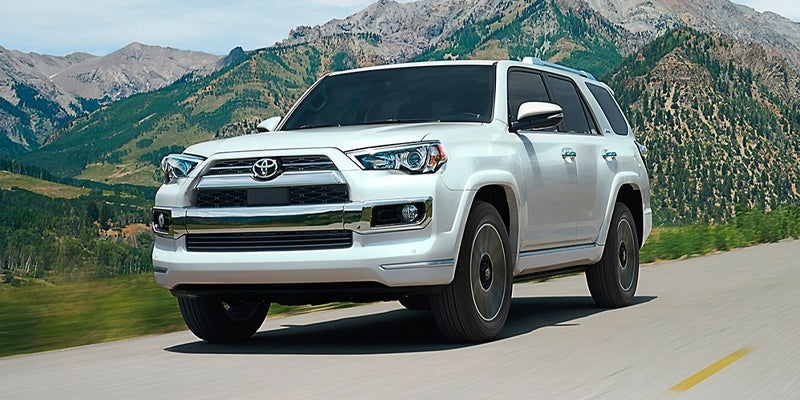
Built on a body-on-frame platform, the 2026 4Runner is offered with both a turbo four-cylinder and an i-FORCE MAX hybrid. Sequoia takes things up a notch with a hybrid V6 making 437 horsepower, 4WD standard, and up to 9,520 pounds of towing capacity. Toyota’s Land Cruiser (listed as a 2027 model on toyota.com) keeps full-time 4WD, a hybrid drivetrain putting out 326 horsepower, and up to 6,000 pounds of towing.
On the truck side, both the Tacoma and Tundra are available with 4WD in standard and i-FORCE MAX hybrid configurations. With the hybrid setup, the Tundra can tow well over 10,000 pounds, perfect for trailers, boats, or heavy equipment.
Electric Toyotas With AWD
Toyota’s electric models are getting in on the action, too. While the difference between AWD and 4WD still applies to EVs, every electric Toyota uses a dual-motor AWD layout. The 2026 bZ offers that setup with up to 343 horsepower and a range of up to 314 miles. Its rugged sibling, the bZ Woodland, adds standard AWD, 375 horsepower, and a tougher attitude for light trail use. And the returning C-HR is now an all-electric crossover with dual-motor AWD producing 338 horsepower and an estimated 287 miles of range.
2026 Toyota AWD and 4WD Lineup at a Glance
| Model | Drivetrain Type | AWD/4WD Status | Starting MSRP |
|---|---|---|---|
| Corolla Hybrid | Hybrid | Available AWD | $25,575 |
| Corolla Cross | Gas | Available AWD | $25,035 |
| Corolla Cross Hybrid | Hybrid | Standard AWD | $29,395 |
| Prius | Hybrid | Available AWD | $28,550 |
| Camry | Hybrid | Available AWD | $29,300 |
| RAV4 Hybrid | Hybrid | Available AWD | $31,900 |
| bZ (Electric) | Electric | Available AWD | $34,900 |
| C-HR (Electric) | Electric | Standard AWD | $37,000 |
| GR Corolla | Turbo Gas | Standard AWD (GR-FOUR) | $40,120 |
| Sienna | Hybrid | Available AWD | $40,420 |
| Crown | Hybrid | Standard AWD | $41,440 |
| RAV4 Plug-in Hybrid | PHEV | Standard AWD | $41,500 |
| Grand Highlander | Turbo Gas | Available AWD | $41,860 |
| 4Runner | Turbo Gas / Hybrid | Available 4WD | $41,870 |
| Crown Signia | Hybrid | Standard AWD | $44,490 |
| Grand Highlander Hybrid | Hybrid | Available AWD | $45,210 |
| bZ Woodland (Electric) | Electric | Standard AWD | $45,300 |
| Highlander | Turbo Gas | Standard AWD (TV-AWD) | $45,870 |
| Highlander Hybrid | Hybrid | Available AWD | $47,620 |
| Tacoma | Gas / Hybrid | Available 4WD | $32,245 |
| Tundra | Gas / Hybrid | Available 4WD | $41,260 |
| Sequoia | Hybrid | Standard 4WD | $65,025 |
| Land Cruiser* | Hybrid | Standard Full-Time 4WD | $57,880 |
*Land Cruiser is currently listed as a 2027 model on Toyota’s website. MSRP figures exclude destination and handling fees. Pricing and availability may vary.
Find Your Next AWD or 4WD Toyota in Madison
With this many options, there’s a Toyota with the right drivetrain for just about every driver. Whether you want a gas-sipping hybrid sedan for rainy commutes or a truck that can handle Indiana back roads, we carry the full 2026 Toyota lineup at Toyota of Madison. If you’re still sorting out the difference between 4 wheel drive and all wheel drive, our team can walk you through each system and help you pick the one that fits your life. Schedule a test drive online, browse our current inventory at toyotaofmadison.net, or stop by in person to get started.
Toyota Built an Electric SUV That Actually Wants to Get Dirty
Toyota’s all-electric lineup has a new addition, and this one was clearly made for people who own a good pair of hiking boots. The bZ Woodland puts off-road hardware, real towing capability, and 375 horsepower into one all-electric package that arrived at U.S. dealerships this March.
- The bZ Woodland produces 375 horsepower from its standard dual-motor all-wheel-drive system, making it the most powerful bZ Toyota has produced.
- EPA-estimated range sits at 281 miles with standard all-season tires, and DC fast charging takes the battery from 10% to 80% in roughly 30 minutes under ideal conditions.
- Standard X-MODE, 8.4 inches of ground clearance, and 3,500-lb towing capacity give the Woodland off-road credentials most electric crossovers simply don’t have.
Built Different From the Start
The bZ Woodland didn’t come from a minor spec adjustment. Compared to Toyota’s standard bZ crossover, the Woodland runs nearly six inches longer, sits slightly taller at the rear, and wears rugged black overfenders that make it look like it has somewhere to be this Saturday morning. Standard roof rails and 18-inch aluminum wheels with aero covers round out an exterior that reads capable without trying too hard.
Under the floor, a 74.7 kWh lithium-ion battery feeds two electric motors for a net output of 375 horsepower. That power goes to all four wheels through Toyota’s X-MODE AWD system, which adjusts torque distribution on loose or slippery surfaces. Ground clearance sits at 8.4 inches, and the bZ Woodland can tow up to 3,500 pounds, enough for a small boat, a loaded utility trailer, or a rack stacked with bikes. Cargo space hits 74.3 cubic feet with the rear seats folded flat, with over 30 cubic feet available behind the second row.
Range and Charging Without the Drama
Toyota rates the 2026 Toyota bZ Woodland at 281 miles of EPA-estimated driving range with standard all-season tires. Opt for the available All-Terrain tires, and that number drops to 260 miles. Neither figure tops the class, but both are workable for weekend trips and daily driving without constant replanning.
The NACS port opens up access to Tesla’s Supercharger network and a wide spread of DC fast chargers. Under ideal conditions, the battery goes from 10% to 80% in about 30 minutes at a Level 3 station. Level 2 AC charging runs through the 11-kW onboard charger and takes roughly seven hours for a full charge, which works well overnight or across a long workday.
Toyota also includes Battery Pre-Conditioning, which prepares the battery for faster DC charging by bringing it to an optimal temperature. Set a fast charger as your navigation destination, and the system handles it automatically. Plug & Charge capability is also included, letting compatible networks identify and authorize your vehicle without extra apps.

Two Grades, One Powertrain
Both grades share the same 74.7 kWh battery, 375-hp dual-motor AWD setup, X-MODE, and off-road hardware. The difference between the bZ Woodland and the Woodland Premium lies entirely in what’s inside the cabin. The base grade covers a lot of ground without feeling stripped down, while the Woodland Premium adds features you’d notice on longer drives.
| Feature | bZ Woodland | bZ Woodland Premium |
|---|---|---|
| Starting MSRP | $45,300 | Contact Dealer |
| Powertrain | 375 hp Dual-Motor AWD | 375 hp Dual-Motor AWD |
| EPA Range (All-Season Tires) | 281 miles est. | 281 miles est. |
| EPA Range (All-Terrain Tires) | 260 miles est. | 260 miles est. |
| Battery Capacity | 74.7 kWh | 74.7 kWh |
| Towing Capacity | 3,500 lbs | 3,500 lbs |
| Ground Clearance | 8.4 in | 8.4 in |
| X-MODE AWD | ✓ | ✓ |
| 14-in Toyota Audio Multimedia Screen | ✓ | ✓ |
| SofTex-Trimmed Seating | ✓ | ✓ |
| Heated Front & Outboard Rear Seats | ✓ | ✓ |
| Heated Steering Wheel | ✓ | ✓ |
| Dual Wireless Qi Charging | ✓ | ✓ |
| Dual-Zone Auto Climate Control | ✓ | ✓ |
| Panoramic View Monitor w/ Multi-Terrain | ✓ | ✓ |
| Ambient Interior Lighting | ✓ | ✓ |
| Standard Roof Rails | ✓ | ✓ |
| Available All-Terrain Tires | ◯ Optional | ◯ Optional |
| JBL Premium Audio | — | ✓ |
| Ventilated Front Seats | — | ✓ |
| Fixed Glass Panoramic Moonroof | — | ✓ |
| Digital Rearview Mirror | — | ✓ |
| Front Seat Radiant Heaters | — | ✓ |
| Driver Seat & Mirror Memory | — | ✓ |
Picking the Right Grade for Your Weekend Plans
The base bZ Woodland covers most buyers well. Heated front- and rear-seat seating, a large touchscreen, dual wireless charging, and genuine off-road hardware all come standard. If you tow a trailer on weekends, occasionally leave the pavement, or want a capable EV that doesn’t look identical to every other crossover, this grade gets the job done.
The Woodland Premium makes sense for drivers who spend more time inside the vehicle. Ventilated seats and front radiant heaters are the real highlights, and the JBL audio system and panoramic moonroof are worth the extra cost on longer drives. Either way, All-Terrain tires are available as an option on both grades for those who want the extra grip on unpaved surfaces.
Six exterior colors are available: Stepping Stone (new for the Woodland), Halo, Steel, Pavement, Raven Black, and Trueno Blue. Base MSRP starts at $45,300 (excluding destination and dealer processing fees), with the Woodland arriving at U.S. dealerships this month.
See the bZ Woodland at Toyota of Madison
As part of the Gates Auto Family, we’ve spent over a century helping drivers find the right vehicle for how they actually live. At Toyota of Madison, we carry the full Toyota lineup, and that now includes the new bZ Woodland. If you want to see both grades in person, compare the feature differences side by side, or take one out for a test drive, stop by our Madison location. Our team will walk you through the powertrain, discuss charging options, and help you determine which configuration best fits your plans. We’re focused on building lasting relationships, not rushing anyone to a decision. Come see what the bZ Woodland is all about.
Main keyword: 2026 Toyota bZ Woodland
Additional keywords: Toyota bZ Woodland electric SUV, bZ Woodland trim levels, Toyota bZ Woodland range, Toyota electric SUV AWD, Toyota bZ Woodland towing capacity, bZ Woodland vs bZ Woodland Premium
Why the 2026 Toyota Tundra Hybrid Belongs on Your Short List
Toyota’s i-FORCE MAX hybrid system turns the Tundra into a truck that can pull a loaded trailer, cruise through town on less fuel, and still feel like a genuine full-size pickup. The 2026 model year carries over the same winning formula with a few welcome updates, and it’s worth a closer look if you’re shopping the half-ton segment.
- The i-FORCE MAX powertrain pairs a 3.4-liter twin-turbo V6 with an electric motor to produce 437 horsepower and 583 lb-ft of torque.
- Tundra Hybrid towing capacity tops out at 11,450 pounds in the Limited RWD configuration, with a 32.2-gallon fuel tank now standard on every trim.
- Five hybrid trims are available, from the well-equipped Limited starting at $58,560 MSRP all the way up to the top-tier Capstone at $80,800 MSRP.
What Powers the 2026 Tundra Hybrid
Under the hood, you’ll find Toyota’s i-FORCE MAX system. It takes the 3.4-liter twin-turbo V6 and adds a motor generator sandwiched between the engine and the 10-speed automatic transmission. That combination puts out 437 horsepower at 5,200 rpm and a stout 583 lb-ft of torque at just 2,400 rpm. For context, the gas-only Tundra makes 389 hp and 479 lb-ft, so the hybrid adds 48 horsepower and over 100 lb-ft of torque without guzzling extra fuel.
Fuel economy sits at an EPA-estimated 20 mpg city and 24 mpg highway for rear-wheel-drive models, which works out to 22 mpg combined. Switch to four-wheel drive, and those numbers dip slightly to 19 city and 22 highway. The TRD Pro, with its beefier off-road suspension and all-terrain tires, returns 18 city and 20 highway. Paired with the 32.2-gallon fuel tank that’s now standard across the board, you’re looking at a potential range of over 700 miles on a single fill-up in the most efficient configuration.
Towing and Hauling Breakdown
The hybrid’s extra torque really shines when you’ve got a trailer hitched up. Depending on your trim, drivetrain, and bed length, tow ratings range from around 10,340 pounds up to 11,450 pounds. A tow hitch receiver and 7/4-pin connector come standard on every 2026 Tundra, which is a new addition this year and a nice touch that saves you a trip to the parts counter.
| Hybrid Trim | Drivetrain | Max Towing (lbs) | MPG (City/Hwy) | Starting MSRP |
|---|---|---|---|---|
| Limited i-FORCE MAX | RWD | 11,450 | 20/24 | $58,560 |
| Platinum i-FORCE MAX | AWD | 11,380 | 19/22 | $70,605 |
| 1794 Edition i-FORCE MAX | AWD | 10,960 | 19/22 | $71,305 |
| TRD Pro | AWD | 10,340 | 18/20 | $72,565 |
| Capstone | AWD | 10,340 | 19/22 | $80,800 |
Payload capacity does take a small hit compared to the gas models because of the hybrid battery, which sits under the rear seats. The Limited hybrid maxes out at around 1,680 pounds of payload versus 1,700 for the gas-only Limited. It’s a minor tradeoff most buyers won’t notice in day-to-day use.
What’s Inside the Cabin
Every Tundra Hybrid comes with a 14-inch touchscreen running Toyota’s Audio Multimedia system, complete with wireless Apple CarPlay and Android Auto. A 12.3-inch digital instrument cluster sits in front of the driver with access to navigation, towing info, off-road readouts, and audio controls. Wireless phone charging and a 12-speaker JBL Premium audio system are standard on every hybrid trim except the Limited.
Toyota Safety Sense 2.5 is included across the lineup, bringing adaptive cruise control, automatic emergency braking with pedestrian and cyclist detection, lane departure alert with steering assist, road sign recognition, and automatic high beams. Blind-spot monitoring with trailer detection also comes standard on all hybrid models, which is a huge plus when you’re towing.
New for 2026, the Capstone trim gets Shale Premium Textured leather seats, while the Limited swaps from SofTex to genuine leather in Boulder or Black. The TRD Pro picks up ISO Dynamic seats as a new option, and a fresh Wave Maker paint color is reserved for that off-road-focused grade.

Off-Road Capability
If dirt roads and trail weekends are your thing, the TRD Pro is the obvious pick. It rides on 2.5-inch FOX coil-over shocks, comes with an electronically locking rear differential, and includes Crawl Control, Multi-Terrain Select, and Downhill Assist Control. A multi-terrain monitor with front, rear, and side cameras gives you a clear view of obstacles before you commit to a line. The TRD Rally Package is also available and adds the iconic tri-color heritage stripe for some visual flair.
Picking the Right Trim for Your Truck Budget
The 2026 Tundra Hybrid lineup covers a lot of ground. If you want the best bang for your buck, the Limited gets you into the hybrid powertrain with leather seats, that big 14-inch screen, and solid towing numbers for under $60,000. Drivers who want the off-road toys should look at the TRD Pro, while the Capstone is built for people who want their truck to feel like a luxury SUV inside. No matter which trim you go with, that 437-hp hybrid powertrain and 583 lb-ft of torque make this a full-size truck that doesn’t ask you to give up much in exchange for a little extra efficiency.
The 2026 Toyota C-HR Returns as a Seriously Quick Electric SUV
Remember the old Toyota C-HR? That quirky little SUV with the wild styling but painfully slow acceleration? Toyota just threw out everything that held it back and created something completely different. The all-electric 2026 Toyota C-HR trades its sluggish gas engine for dual electric motors that rocket it to 60 mph in about five seconds. That’s faster than most sports sedans and leaves the original model eating dust at every stoplight.
- The 2026 C-HR packs 338 horsepower from dual electric motors, hitting 60 mph in roughly 5 seconds compared to the gas model’s painful 11-second sprint.
- Buyers get an estimated 290 miles of range from the 74.7 kWh battery, with DC fast charging that can go from 10% to 80% in about 30 minutes.
- Expected pricing sits between $38,000 and $45,000, putting it up against the Hyundai Kona Electric, Kia Niro EV, and Chevrolet Equinox EV when it arrives in Fall 2026.
Quick Reference Chart
| Powertrain & Performance | |
|---|---|
| Motors | Dual electric (front & rear) |
| Total Output | 338 horsepower |
| Drivetrain | Standard AWD |
| 0-60 mph | ~5.0 seconds |
| Battery | 74.7 kWh lithium-ion |
| Estimated Range | 290 miles |
| Charging Capabilities | |
| Charge Port | NACS (Tesla Supercharger compatible) |
| DC Fast Charge | 10-80% in ~30 minutes |
| AC Charging | Up to 11 kW |
| Features | Plug & Charge, battery preconditioning |
| Interior & Technology | |
| Seating | 5 passengers |
| Cargo Space | 25.4 cubic feet (rear seats up) |
| Touchscreen | 14 inches |
| Audio | 6-speaker standard, 9-speaker JBL optional |
| Standard Features | Wireless Apple CarPlay/Android Auto, dual wireless chargers, heated front seats, heated steering wheel, digital instrument cluster |
| Safety & Driver Assistance | |
| Suite | Toyota Safety Sense 3.0 |
| Standard Features | Automatic emergency braking with pedestrian detection, adaptive cruise control, lane keeping assist, blind spot monitoring, rear cross-traffic alert, traffic sign recognition, automatic high beams |
| Dimensions & Design | |
| Wheels | 18-inch standard, 20-inch available |
| Design Theme | “Hammerhead” front styling |
| Roof | Available panoramic moonroof |
| Notable Features | Hidden rear door handles, full-width rear light bar |
| Pricing & Availability | |
| Trims | SE (base), XSE (premium) |
| Estimated Price | $38,000-$45,000 |
| Release | Fall 2026 |
What Makes This C-HR Different From Before
Back in 2018, the first-generation C-HR showed up with aggressive styling that turned heads, but the driving experience didn’t match the looks. That old four-cylinder engine took over 11 seconds to reach 60 mph, making highway merging a white-knuckle experience. Cabin noise was brutal, and visibility felt like peering through a tank’s gunport. Toyota basically said, “Let’s fix all of that,” and started from scratch.
This new electric version keeps the bold design language but makes it work better. Up front, you get Toyota’s latest “Hammerhead” styling, which honestly looks way better than those oversized grilles from a few years back. Sharp body lines run down the sides, and there’s still that coupe-like roofline that made the original stand out. Out back, a full-width light bar looks properly modern. Those hidden rear door handles are back too, which some people love, and others find annoying when trying to let passengers in.
Inside is where things get really different. Gone are the cheap plastics and dated tech. You get a huge 14-inch touchscreen sitting front and center, with a digital gauge cluster tucked deep into the dashboard. Base SE trim comes with fabric seats and SofTex (Toyota’s synthetic leather) bolsters, while the XSE steps up to full SofTex with synthetic suede accents. Both trims include heated front seats and a heated steering wheel, which is nice to see as standard equipment rather than buried in option packages.
Performance That Actually Delivers
Here’s where things get fun. Two electric motors (one up front, one in back) team up to produce 338 horsepower and standard all-wheel drive. That five-second 0-60 time puts it in muscle car territory. You’re talking some serious speed here, and that instant torque from electric motors means the power hits immediately when you step on it.
A 74.7 kWh battery pack lives in the floor, which helps keep the center of gravity low and should improve handling. Toyota estimates you’ll get 290 miles per charge, which puts it right in the mix with other compact electric SUVs. That’s enough for most people’s daily driving plus weekend trips without constantly worrying about finding a charger.
Speaking of charging, the C-HR comes with a NACS port, which means you can plug into Tesla’s Supercharger network along with other DC fast chargers. Under ideal conditions, you can go from 10% to 80% battery in about 30 minutes. Built-in battery preconditioning warms things up when you’re heading to a charger, which helps speed up the charging process. For home charging, the onboard 11 kW AC charger means overnight top-ups should be no problem.

Tech Features Worth Talking About
Toyota’s been playing catch-up on the tech front for years, but they’re finally getting it right. That 14-inch touchscreen houses the Toyota Audio Multimedia system with wireless Apple CarPlay and Android Auto. You can also link your Apple Music or Amazon Music accounts directly through Integrated Streaming, so you don’t have to fumble with your phone.
A standard six-speaker audio system is fine, but the optional nine-speaker JBL setup with an 800-watt amplifier and dedicated subwoofer is the way to go if you care about sound quality. Dual wireless charging pads mean you and your passenger can both keep phones topped up without cables everywhere.
Stepping up to the XSE trim adds some nice upgrades like a 360-degree camera system (super helpful for parking), a digital rearview mirror, and lane-change assist. There’s also Traffic Jam Assist on the XSE, which combines adaptive cruise and lane keeping to reduce fatigue when you’re stuck in stop-and-go traffic.
Safety Comes Standard
Toyota Safety Sense 3.0 is standard across the board, which means you get automatic emergency braking with pedestrian detection, lane keeping assist, adaptive cruise control, blind spot monitoring, rear cross-traffic alert, and automatic high beams. There’s also Toyota’s Proactive Driving Assist, though some drivers find it a bit too eager to intervene.
One feature that stands out is the safe exit assist system. It monitors for passing vehicles before letting passengers open the doors, which could prevent accidents in busy parking lots or on city streets. The five-year trial for connected safety services includes an SOS button for emergencies, automatic crash notification, and a stolen vehicle locator.
How It Stacks Up Against Competitors
Electric compact SUV competition is getting crowded. Chevrolet’s Equinox EV starts around $35,000 and offers up to 319 miles of range. Hyundai’s Kona Electric delivers 261 miles for about $33,000. Kia’s Niro EV gets 253 miles and pricing similar to the Kona. Volvo’s EX30 is a bit pricier but offers European styling and build quality.
What sets the C-HR apart from competitors is that combination of standard all-wheel drive, quick acceleration, and Toyota’s reputation for building vehicles that last. Plus, that bold styling either grabs you or it doesn’t. You won’t mistake it for anything else on the road, which matters if you don’t want to look like everyone else in the school pickup line.
Should You Wait For It
Fall 2026 arrival means you’ve got some time to think about it. That’s actually good news because it gives Toyota time to work out any bugs and for early reviews to come in. Plus, the electric vehicle market keeps evolving, so waiting might mean better charging infrastructure and potentially better deals.
If you’re coming from the old C-HR, this new version fixes basically every complaint. If you’re shopping for your first electric vehicle, the C-HR offers a good mix of style, performance, and range without making you learn a completely new brand. And if you’re looking at other compact electric SUVs, that quick acceleration and standard AWD might be enough to sway you, especially if you live somewhere with actual winter weather.
Expected pricing between $38,000 and $45,000 puts it in competitive territory. Base SE trim should offer plenty of features for most buyers, while the XSE adds some nice-to-haves like better cameras and fancier seats. Toyota hasn’t released final pricing yet, so there’s a chance these numbers could shift either direction.
Test Drive the Electric Future at Toyota of Madison
When the 2026 Toyota C-HR arrives, we’ll have it ready for you to experience at Toyota of Madison. Being able to feel that instant electric acceleration and see the tech features in person makes a huge difference compared to just reading specs online. We’re located at 258 Clifty Drive in Madison, Indiana, and our team has been helping customers navigate the shift to electric vehicles with straightforward answers and real-world insights.
As part of the Gates Auto Family since 1915, we’ve seen the automotive world change quite a bit over the decades. Electric vehicles represent the biggest shift we’ve experienced, and we make it our job to help you understand what it means for your daily driving. Our Toyota-trained technicians are already getting up to speed on EV maintenance and service, so you’ll have expert support long after you drive home. Give us a call at (812) 273-3135 or stop by to learn more about the C-HR and other electrified Toyota models coming your way.
Introducing the 2026 Toyota RAV4
Toyota just dropped the sixth-generation RAV4, and it’s going all-in on hybrid power. The 2026 model ditches the traditional gas engine completely, making every single RAV4 a hybrid or plug-in hybrid. What does that mean for buyers? Better fuel economy, more power, and a compact SUV that’s ready for whatever you throw at it.
- Every 2026 Toyota RAV4 comes standard with hybrid power, delivering up to 236 horsepower and an estimated 44 mpg combined.
- Plug-in hybrid models pack 320 horsepower and 50 miles of electric-only driving range with DC fast charging on select trims.
- Three different design styles (Core, Rugged, and Sport) give buyers the freedom to pick a RAV4 that matches their personality and needs.
What Makes This Generation Different
Toyota redesigned the RAV4 from the ground up. Those hammerhead LED headlights and chiseled body panels give it serious presence on the road. You can get wheels ranging from 17 inches up to 20 inches, depending on which trim you pick.
Under the skin, the TNGA-K platform gets reinforced frame joints and suspension mounting points. Better handling and a smoother ride are the payoff. High-damping adhesives help cut down on road noise, too, so your highway drives stay quiet.
Power Options That Actually Make Sense
Here’s the thing about the new powertrain setup. That base hybrid pairs a 2.5-liter four-cylinder with electric motors. Front-wheel drive models make 226 horsepower, while all-wheel drive bumps that to 236. You’re getting more grunt than the old gas-only RAV4 with way better fuel economy at the same time.
Plug-in hybrid models take it up a notch. With 320 combined horsepower, these things really move. You get 50 miles of electric-only range (up from 42 in the previous generation), and on the XSE and Woodland PHEV trims, DC fast charging can take you from 10% to 80% in about 30 minutes. Perfect for daily driving where you barely need gas at all.
All-wheel drive comes standard on the PHEV, and towing capacity hits 3,500 pounds on select AWD grades. Front-wheel drive and base AWD models pull 1,750 pounds.
Three Flavors to Pick From
Toyota split the RAV4 lineup into three different personalities. Core models cover LE, XLE Premium, and Limited grades. Think of this as your everyday driver with a clean, modern look. Paint-matched grilles and that signature hammerhead front end give it a polished appearance.
Woodland takes the rugged route. It’s now a standalone grade with SofTex interior trim, available all-terrain tires, and extra ground clearance. A 3D multi-terrain monitor helps you see what’s under your wheels when you’re off the beaten path. Toyota even threw in new colors like Urban Rock specifically for this trim.
Sport trims round out the lineup. SE and XSE models bring available 20-inch wheels, blue interior stitching, and two-tone paint options. But the star of the show is the new GR SPORT trim. Toyota Gazoo Racing got its hands on this one, adding a tuned suspension, performance steering, summer tires, and a functional MATRIX grille. First time the RAV4 has gotten the GR treatment.
Tech That Actually Works
Slide into the driver’s seat and you’ll notice Toyota finally updated the interior tech. A 12.3-inch digital gauge cluster comes standard across the lineup. Touchscreens can go up to 12.9 inches, running Toyota’s new Audio Multimedia system with AT&T 5G connectivity.
Think of the interface like your smartphone. You get customizable widgets on the home screen, faster “Hey Toyota” voice commands, and integrated turn-by-turn navigation that displays right in the gauge cluster. Wireless Apple CarPlay and Android Auto come standard, plus dual Bluetooth phone connectivity.
Safety gets a serious upgrade, too. This 2026 Toyota RAV4 is the first Toyota to launch with Safety Sense 4.0. Better lane-keeping, improved collision mitigation, and traffic sign recognition all come standard. There’s also a built-in drive recorder that uses the vehicle’s exterior cameras to capture footage.
When Can You Get One
Expect the 2026 RAV4 to start showing up at dealerships late 2025 or early 2026. Pricing hasn’t been announced yet, but it should land somewhere competitive with other compact SUVs in its class. With the hybrid-only lineup, you’re getting better efficiency and stronger performance in the same package.
Worth Checking Out in Person
Curious to see what the new RAV4 looks like in person? Swing by Toyota of Madison at 258 Clifty Drive in Madison, IN. Their team knows the RAV4 inside and out, and they’ve got a solid selection on the lot. Whether you’re shopping for a new ride or just want to check out what’s changed, they can walk you through all the trim levels, answer your questions, and set you up with a test drive. Part of the Gates Auto Family since 1915, they’ve been helping drivers in Madison and the surrounding Indiana, Kentucky, and Ohio areas find the right Toyota for over a century. Their ASE-certified service team is there for you after the sale, too.
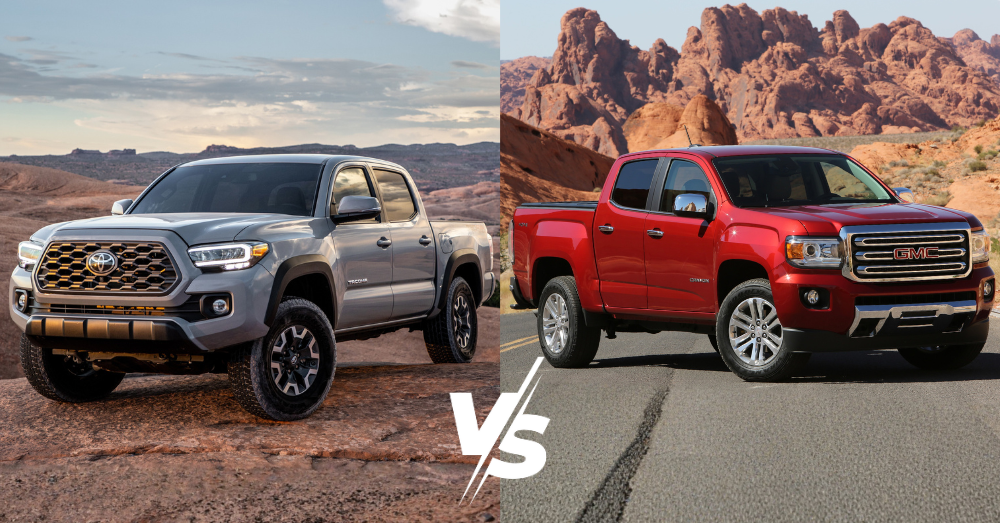
Walk into any construction site, farm, or trailhead parking lot and you’ll see way more Tacomas than Canyons. That’s not random. When you compare the Toyota Tacoma vs GMC Canyon for buyers who actually use their trucks, it’s pretty clear: the Tacoma delivers where it counts. It gives you reliability you can bet on, resale value that protects your wallet, and the flexibility to match how you work. The Canyon might look good on paper with its higher towing numbers and upscale interior, but real-world performance tells a different story. That’s exactly why so many truck owners choose their Tacoma from Toyota Of Madison.
- The Tacoma holds over 82% of its value after three years compared to the Canyon’s steeper depreciation, saving you thousands when you sell or trade.
- Toyota offers 11 different Tacoma trims with two cab sizes and two bed lengths, while GMC gives you just three trims and one configuration.
- The Tacoma’s hybrid option pumps out 326 horsepower and gets better gas mileage than the Canyon’s single engine choice.
The Numbers That Actually Matter
Yes, the Canyon can tow 7,700 pounds while the Tacoma maxes out at 6,500. But here’s what the spec sheets don’t tell you: most people aren’t maxing out their towing capacity every weekend. What you will do is drive this truck to work, haul materials, throw gear in the bed, and rack up miles. When looking at the Toyota Tacoma vs GMC Canyon on power alone, the Tacoma’s turbocharged 2.4-liter engine gives you 278 horsepower in most trims, and if you grab a hybrid model, you get 326 horses with 465 pound-feet of torque. The Canyon delivers 310 horsepower and 430 pound-feet, which is solid but doesn’t match the hybrid Tacoma.
Here’s where it gets interesting: the Tacoma’s hybrid option earns up to 24 MPG combined. The Canyon? You’re looking at 19 city and 23 highway with rear-wheel drive. Drop to 17-20 MPG if you add four-wheel drive and bigger tires. When you’re filling up twice a week, those numbers add up fast.
Resale Value Tells the Real Story
This is where the Tacoma absolutely crushes the competition. Research shows the Tacoma retains over 82% of its original value after three years. That’s the best resale value in the entire vehicle market. The Canyon? It depreciates faster. A lot faster. If you buy a $45,000 Tacoma today, you could sell it for around $37,000 in three years. With a Canyon, you’re losing several thousand dollars more.
Why does this happen? Buyers trust Toyota’s reputation. Tacomas routinely run past 200,000 miles without major issues. That 2015 Tacoma your neighbor still drives? It probably has 150,000 miles and runs like it’s half that age. Canyon owners can’t claim the same track record.
Customization Wins Jobs
The Canyon comes in three flavors: Elevation, AT4, and Denali. One cab size. One bed length. That’s it. The Tacoma lineup? Eleven different trims ranging from the basic SR to the off-road focused TRD Pro and the new Trailhunter. You can get a two-passenger XtraCab or a five-passenger Double Cab. Choose between a 5-foot or 6-foot bed.
This matters when you’re buying a work truck. Need a long bed for lumber and pipe? Tacoma has you covered. Want a smaller cab to keep costs down? Done. The Canyon forces you into one setup whether it fits your needs or not.
Daily Driver Comfort Without the Premium
The Canyon Denali has a nice interior with leather and chrome. It also starts around $50,000. The Tacoma SR5 gives you a comfortable cabin, modern tech, and everything you need for around $35,000. That’s fifteen grand in your pocket for tools, accessories, or your next down payment.
Both trucks offer big touchscreens, smartphone integration, and decent sound systems. The Tacoma’s available 14-inch display is one of the biggest in the segment. Safety tech comes standard on all Tacomas through Toyota Safety Sense 3.0, including automatic emergency braking and lane-keeping assist.
Off-Road Capability That’s Proven
The Canyon AT4X with its locking differentials and lifted suspension is genuinely capable off-road. The problem? It costs over $65,000. A Tacoma TRD Off-Road gives you similar capability for twenty grand less. Want the absolute best? The TRD Pro and Trailhunter models have been tested on the most punishing trails in the world and come out winning.
Toyota’s multi-terrain select system, crawl control, and available locking rear differential make the Tacoma a legitimate trail truck. The Canyon can hang, but the Tacoma has decades of off-road heritage backing it up.
Real Talk About Ownership
When something breaks on your Canyon, you’re dealing with GM parts availability and pricing. When something breaks on your Tacoma (and it probably won’t for a while), Toyota parts are available at Toyota of Madison and usually cost less. Every mechanic knows how to work on a Tacoma. Finding someone familiar with the Canyon’s 2.7-liter turbo might take longer.
The Tacoma also comes with Toyota’s two-year complimentary maintenance. The Canyon gives you one visit in the first year. Over five years, this saves you hundreds in oil changes and service. This ownership cost difference makes the Toyota Tacoma vs GMC Canyon decision pretty clear for anyone watching their budget.
The Bottom Line for Working Trucks
If you’re buying a truck as a fashion statement, maybe the Canyon’s upscale interior wins you over. But for people who actually use their trucks, haul equipment, hit trails on weekends, and need something that starts every morning for the next decade, the Tacoma is the smarter buy. Lower entry price, better resale value, proven reliability, and more options to match your exact needs. When you weigh the Toyota Tacoma vs GMC Canyon side by side, that’s why you see more Tacomas at job sites than any other midsize truck.
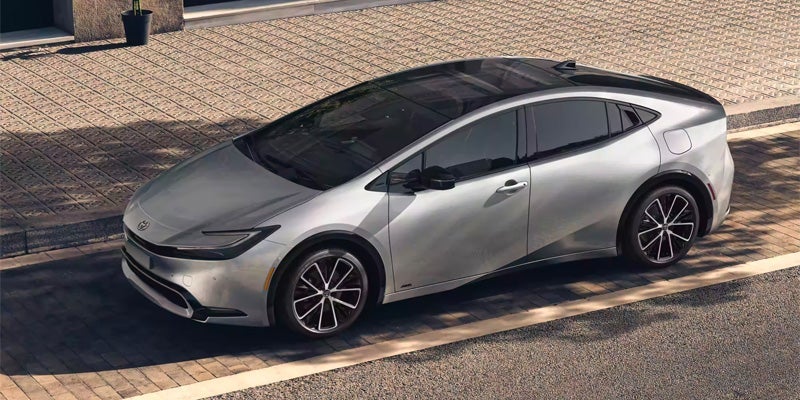
Exploring the 2024 Toyota Prius: A Green Icon
If you’re looking for an eco-friendly ride that offers top-notch performance, exceptional safety features, and all of the modern amenities you could want from a cutting-edge ride, the 2024 Toyota Prius will undoubtedly deliver. This iconic vehicle is kind to the environment and allows you to explore wherever your imagination can take you. This precision machine is the ultimate fusion of efficiency and performance.

Efficient and Powerful
With a combined mpg of 57, you can cruise and explore for longer. Plus, with outstanding performance and handling, you can seamlessly go from the city streets to the unexplored country without missing a beat. This vehicle has plenty of great built-in features, like LED headlights and heated mirrors that stay free from condensation and provide total rear visibility.
The variable intermittent windshield wipers automatically adjust to keep your windshield clear, making it great for driving in tricky weather. Plus, this vehicle handles like a dream, with front-wheel drive and electric power steering that make it easy to glide around curves and Independent MacPherson strut front suspension that keeps you firmly grounded and in control.
Comfortable and Well-Appointed Interior
These ultramodern vehicles are equipped with everything you need for a fantastic journey, including a driver’s seat that you can adjust in six different ways for personalized comfort every mile of the way and a push-button start so you can hop in and go.
Additionally, you can customize the rear seat to fit more people or additional gear, and there are multiple USB chargers in the front and rear, so you and your passengers never have to worry about arriving at your destination with a depleted phone battery. Additionally, these vehicles sync up perfectly with Android Auto, Apple CarPlay, and SiriusXM, giving you hours of entertainment options that you can enjoy over a six-speaker system.
State-of-the-Art Safety Features
These vehicles certainly put your safety first, with a suite of smart features that will help you drive with total confidence. Enjoy Toyota Safety Sense 3.0, which includes excellent features like the Pre-Collision System with Pedestrian Detection, which alerts you to obstacles ahead and helps you avoid accidents, and Lane Departure Alert with Steering Assist, which is excellent for highway driving and can keep you from weaving out of your lane.
This environmentally friendly and ultra sophisticated ride is at the top of its class in performance, amenities, and excellent safety features. It’s a thoroughly modern, comfortable, and safe vehicle that can help you explore the open road in a completely green way. If it’s time for you to upgrade your vehicle, check out the new Prius model. Visit Toyota of Madison in Madison, IN, and take one of these phenomenal vehicles for a spin today.