

Blog / Madison Toyota Dealer

2026 Toyota Tundra Hybrid Features and Capabilities

2026-Toyota-Tundra-Hybrid-Features-and-Capabilities

Why the 2026 Toyota Tundra Hybrid Belongs on Your Short List

Toyota's i-FORCE MAX hybrid system turns the Tundra into a truck that can pull a loaded trailer, cruise through town on less fuel, and still feel like a genuine full-size pickup. The 2026 model year carries over the same winning formula with a few welcome updates, and it's worth a closer look if you're shopping the half-ton segment.

  • The i-FORCE MAX powertrain pairs a 3.4-liter twin-turbo V6 with an electric motor to produce 437 horsepower and 583 lb-ft of torque.
  • Tundra Hybrid towing capacity tops out at 11,450 pounds in the Limited RWD configuration, with a 32.2-gallon fuel tank now standard on every trim.
  • Five hybrid trims are available, from the well-equipped Limited starting at $58,560 MSRP all the way up to the top-tier Capstone at $80,800 MSRP.

What Powers the 2026 Tundra Hybrid

Under the hood, you'll find Toyota's i-FORCE MAX system. It takes the 3.4-liter twin-turbo V6 and adds a motor generator sandwiched between the engine and the 10-speed automatic transmission. That combination puts out 437 horsepower at 5,200 rpm and a stout 583 lb-ft of torque at just 2,400 rpm. For context, the gas-only Tundra makes 389 hp and 479 lb-ft, so the hybrid adds 48 horsepower and over 100 lb-ft of torque without guzzling extra fuel.

Fuel economy sits at an EPA-estimated 20 mpg city and 24 mpg highway for rear-wheel-drive models, which works out to 22 mpg combined. Switch to four-wheel drive, and those numbers dip slightly to 19 city and 22 highway. The TRD Pro, with its beefier off-road suspension and all-terrain tires, returns 18 city and 20 highway. Paired with the 32.2-gallon fuel tank that's now standard across the board, you're looking at a potential range of over 700 miles on a single fill-up in the most efficient configuration.

Towing and Hauling Breakdown

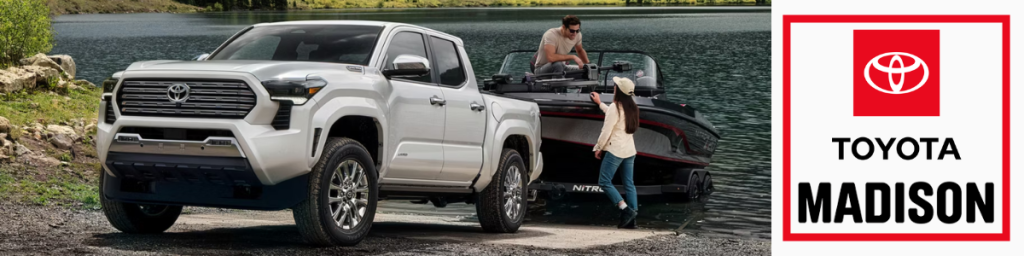
The hybrid's extra torque really shines when you've got a trailer hitched up. Depending on your trim, drivetrain, and bed length, tow ratings range from around 10,340 pounds up to 11,450 pounds. A tow hitch receiver and 7/4-pin connector come standard on every 2026 Tundra, which is a new addition this year and a nice touch that saves you a trip to the parts counter.

Hybrid TrimDrivetrainMax Towing (lbs)MPG (City/Hwy)Starting MSRP
Limited i-FORCE MAXRWD11,45020/24$58,560
Platinum i-FORCE MAXAWD11,38019/22$70,605
1794 Edition i-FORCE MAXAWD10,96019/22$71,305
TRD ProAWD10,34018/20$72,565
CapstoneAWD10,34019/22$80,800

Payload capacity does take a small hit compared to the gas models because of the hybrid battery, which sits under the rear seats. The Limited hybrid maxes out at around 1,680 pounds of payload versus 1,700 for the gas-only Limited. It's a minor tradeoff most buyers won't notice in day-to-day use.

What's Inside the Cabin

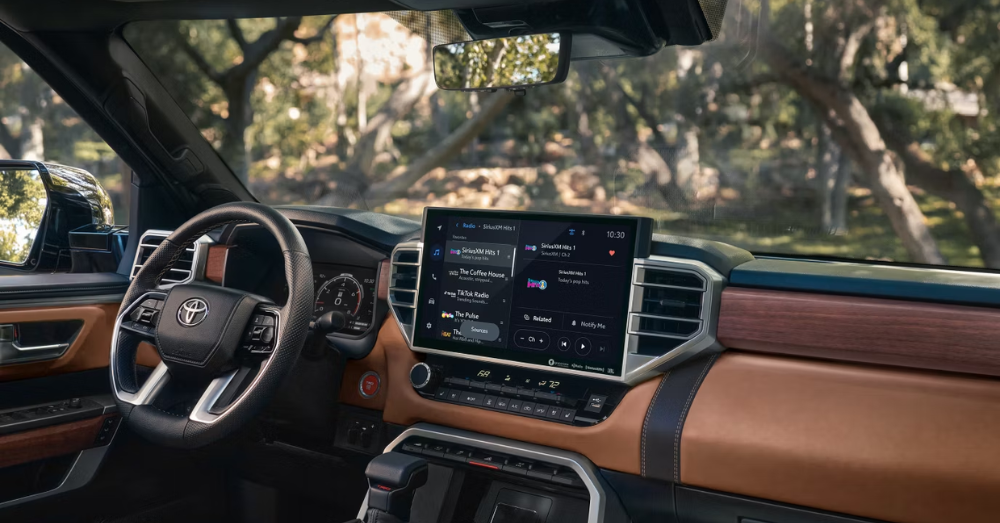
Every Tundra Hybrid comes with a 14-inch touchscreen running Toyota's Audio Multimedia system, complete with wireless Apple CarPlay and Android Auto. A 12.3-inch digital instrument cluster sits in front of the driver with access to navigation, towing info, off-road readouts, and audio controls. Wireless phone charging and a 12-speaker JBL Premium audio system are standard on every hybrid trim except the Limited.

Toyota Safety Sense 2.5 is included across the lineup, bringing adaptive cruise control, automatic emergency braking with pedestrian and cyclist detection, lane departure alert with steering assist, road sign recognition, and automatic high beams. Blind-spot monitoring with trailer detection also comes standard on all hybrid models, which is a huge plus when you're towing.

New for 2026, the Capstone trim gets Shale Premium Textured leather seats, while the Limited swaps from SofTex to genuine leather in Boulder or Black. The TRD Pro picks up ISO Dynamic seats as a new option, and a fresh Wave Maker paint color is reserved for that off-road-focused grade.
Off-Road Capability

If dirt roads and trail weekends are your thing, the TRD Pro is the obvious pick. It rides on 2.5-inch FOX coil-over shocks, comes with an electronically locking rear differential, and includes Crawl Control, Multi-Terrain Select, and Downhill Assist Control. A multi-terrain monitor with front, rear, and side cameras gives you a clear view of obstacles before you commit to a line. The TRD Rally Package is also available and adds the iconic tri-color heritage stripe for some visual flair.

Picking the Right Trim for Your Truck Budget

The 2026 Tundra Hybrid lineup covers a lot of ground. If you want the best bang for your buck, the Limited gets you into the hybrid powertrain with leather seats, that big 14-inch screen, and solid towing numbers for under $60,000. Drivers who want the off-road toys should look at the TRD Pro, while the Capstone is built for people who want their truck to feel like a luxury SUV inside. No matter which trim you go with, that 437-hp hybrid powertrain and 583 lb-ft of torque make this a full-size truck that doesn't ask you to give up much in exchange for a little extra efficiency.
Posted in:

Related Posts

Built-to-Pull-Toyota-Tacoma-Towing-Capacity-by-Trim-&-Configuration

Built to Pull: Toyota Tacoma Towing Capacity by Trim & Configuration

What a Tacoma Can Pull, Trim by Trim Backing a loaded trailer down a boat ramp is where a spec sheet gets real. One number on your door jamb decides how that morning goes. And across the 2026 Tacoma lineup, that number varies by 3,000 pounds. Gas-powered XtraCab models carry the highest rating in the lineup at 6,500 pounds. Gas Double Cab trucks pull 6,400 pounds, while a base SR with the automatic stops at 3,500 pounds. Every i-FORCE MAX hybrid tops out between 5,950 and 6,000 pounds because of the weight it carries. Two Engines, Two Sets of Numbers Toyota builds the 2026 Tacoma around a 2.4-liter turbocharged four-cylinder. It gets tuned three ways. The base SR pairs with an eight-speed automatic, producing 228 horsepower and 243 lb-ft of torque. Most trims above the SR run the same block at 278 horsepower and 317 lb-ft of torque. Want the six-speed manual? It shows up on 4x4 Double Cab builds and makes 270 horsepower and 310 lb-ft of torque. The i-FORCE MAX adds an electric motor to that turbo four. Output climbs to 326 horsepower and 465 lb-ft, and the Trailhunter is rated at 323 horsepower. Torque hits the instant you touch the pedal. You notice that pulling a wet boat up a steep ramp. How Toyota Tacoma Towing Capacity Breaks Down by Trim Toyota Tacoma towing capacity runs from 3,500 to 6,500 pounds. Cab style matters more than badge here. Gas XtraCab trucks, meaning SR5 and TRD PreRunner, hit the 6,500-pound ceiling. Add the back doors and gas Double Cab models settle at 6,400 pounds. That 100-pound gap rarely changes a shopping list. It does count if your trailer already sits near the limit. The base SR is the odd one out. Toyota lists it at 3,500 pounds in every cab and drivetrain it offers, which puts a hard ceiling on what the entry truck will pull. Step up one rung to the SR5, and the rating nearly doubles. Every figure below assumes a properly equipped truck and follows SAE J2807 test methods. 2026 Tacoma Tow Ratings by Trim and Configuration Trim and Powertrain Cab and Drive Max Towing (lbs.) Max Tongue Weight (lbs.) Trailer Brake Controller SR (i-FORCE) XtraCab or Double Cab, 4x2 or 4x4 3,500 640 to 650 Not offered SR5 (i-FORCE) XtraCab, 6-ft. bed 6,500 650 Package SR5 (i-FORCE) Double Cab, 4x2 or 4x4 6,400 640 Package TRD PreRunner (i-FORCE) XtraCab 4x2, 6-ft. bed 6,500 650 Package TRD Sport (i-FORCE) Double Cab, 4x2 or 4x4 6,400 640 Package TRD Off-Road (i-FORCE) Double Cab 4x4 6,400 640 Package Limited (i-FORCE) Double Cab 4x4 6,400 640 Standard TRD Sport (i-FORCE MAX) Double Cab 4x4 5,950 to 6,000 595 to 600 Package TRD Off-Road (i-FORCE MAX) Double Cab 4x4 5,950 to 6,000 595 to 600 Package Limited (i-FORCE MAX) Double Cab 4x4 5,950 to 6,000 595 to 600 Standard Trailhunter (i-FORCE MAX) Double Cab 4x4 5,950 to 6,000 595 to 600 Standard TRD Pro (i-FORCE MAX) Double Cab 4x4 5,950 to 6,000 595 to 600 Standard Ratings are Toyota figures for properly equipped trucks tested to SAE J2807. Confirm the numbers on your own door jamb sticker before you hitch up. Why the Hybrid Numbers Land Lower Most shoppers expect the strongest engine to pull the most. The 6,000-pound hybrid ceiling surprises them. Battery and motor hardware push curb weight to between 5,030 and 5,410 pounds. That mass eats into the gross combined rating. You trade about 400 pounds of trailer for instant low-end grunt, a 2400W bed outlet, and standard Tow/Haul mode. Tongue Weight Counts Against Your Payload Tongue weight usually runs 10 to 15 percent of what the trailer weighs. It presses straight down on the hitch. Gas XtraCab trucks handle 650 pounds at the ball, gas Double Cabs 640, and hybrids 595 to 600. That load comes out of the payload. Payload spans 1,230 pounds on a 4x4 XtraCab up to 1,710 pounds on some hybrid Double Cabs. Add riders, coolers, and a toolbox, and the margin shrinks fast. Trailer Tech Worth Ordering A Class-IV hitch receiver with 7-pin and 4-pin wiring is standard on SR5, TRD PreRunner, TRD Sport, and TRD Off-Road. Limited, TRD Pro, and Trailhunter add Trailer Backup Guide and a trailer blind-spot camera. Those three also include the built-in trailer brake controller. SR5, TRD PreRunner, TRD Sport, and TRD Off-Road bundle it into option packages, and the SR skips it altogether. Towing a tandem-axle trailer? Treat that controller as a must-have. Picking a Build That Matches Your Trailer Weigh your trailer loaded, with coolers, gear, and a full water tank. Then shop backward from that number. Anything heavier than 6,400 pounds points you toward a gas XtraCab, meaning an SR5 or TRD PreRunner. Trailers in the 4,000 to 5,500 range open up most of the lineup, hybrids included. Those builds still leave room for a family in the back seat. Light utility and single-axle boat trailers under 3,500 pounds fit even the base SR. Talk Tow Ratings With Us at Toyota of Madison We stock Tacomas in a mix of cabs, beds, and powertrains. Towing needs around here run from a jon boat to a loaded equipment trailer. Bring us your trailer weight, and we'll walk you out to trucks that match it. We'll open the doors and read the ratings with you. We'll also cover hitch setup, brake controller choices, and wiring before you sign anything. Our Toyota-trained techs handle the follow-up, from hitch installs to the service a hardworking truck needs. Drivers from Madison, Scottsburg, Seymour, and across the river in Louisville know we'd rather spend the extra ten minutes up front.

Two-Icons-One-Choice-2026-Toyota-Camry vs-Honda-Accord

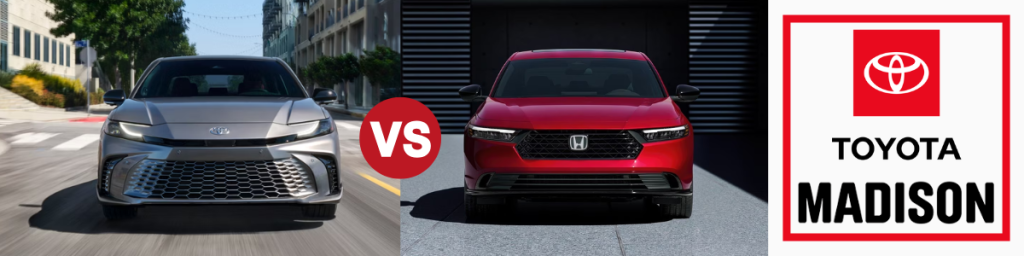
Two Icons, One Choice: 2026 Toyota Camry vs. Honda Accord

How the 2026 Camry and Accord Match Up for Daily Drivers America's two best-selling sedans have traded punches for decades, and 2026 keeps the rivalry going strong. Toyota went all-in on hybrid power for every Camry this year, while Honda still sells a gas Accord and saves its hybrid setup for the upper trims. Both seat five, both sip fuel, and both have loyal fans who swear by their pick. So which one belongs in your driveway? Every 2026 Camry comes as a hybrid, starting at $29,300 and rated up to 51 mpg combined on the LE grade. Honda's 2026 Accord starts lower at $28,395 with a turbo gas engine, and its hybrid trims reach up to 48 mpg combined. Toyota offers all-wheel drive on every Camry trim, while the Accord stays front-wheel drive across the whole lineup. What's Under the Hood This is where the two cars split in a big way. Every 2026 Camry runs a 2.5L four-cylinder hybrid paired with an eCVT. Front-drive models make 225 horsepower combined, and the available all-wheel-drive setup bumps that to 232. You get the same hybrid no matter which Camry you choose. Honda plays it differently. Base LX and SE trims use a 1.5L turbocharged four-cylinder good for 192 horsepower and 192 lb-ft of torque, with a CVT. Want the hybrid? You'll step up to the Sport Hybrid or higher, which runs a 2.0L two-motor system rated at 204 horsepower and a strong 247 lb-ft of torque. That tradeoff sits at the heart of the 2026 Toyota Camry vs. Honda Accord question. Toyota gives you hybrid power from the jump, and Honda lets you start cheaper on gas before paying up for electrification. Fuel Economy by the Numbers Toyota's all-hybrid plan pays off at the pump. In front-drive form, the Camry LE earns an EPA-estimated 52 city, 49 highway, and 51 combined. Sportier SE, XLE, and XSE trims land around 47/45/46. Adding AWD trims those numbers a touch. Honda's gas Accord LX returns 29 city, 37 highway, and 32 combined, with the SE close behind at 28/36/31. Move to the hybrids, and the gap shrinks fast. Most Accord hybrids hit 46/41/44, and the EX-L Hybrid is the mileage champ of the bunch at 51/44/48. Camry still edges ahead on combined numbers, but a hybrid Accord is no slouch. Trim-by-Trim Breakdown Trim Powertrain Horsepower Combined MPG Starting MSRP 2026 Toyota Camry (Hybrid, FWD or AWD) LE 2.5L Hybrid 225 hp (FWD) 51 $29,300 SE 2.5L Hybrid 225 hp (FWD) 46 $31,800 Nightshade 2.5L Hybrid 225 hp (FWD) 46 $32,800 XLE 2.5L Hybrid 225 hp (FWD) 46 $34,500 XSE 2.5L Hybrid 225 hp (FWD) 46 $35,700 2026 Honda Accord (Gas or Hybrid, FWD only) LX 1.5L Turbo Gas 192 hp 32 $28,395 SE 1.5L Turbo Gas 192 hp 31 $30,695 Sport Hybrid 2.0L Hybrid 204 hp 44 $33,795 EX-L Hybrid 2.0L Hybrid 204 hp 48 $35,095 Sport-L Hybrid 2.0L Hybrid 204 hp 44 $35,495 Touring Hybrid 2.0L Hybrid 204 hp 44 $39,495 Prices exclude the $1,195 destination charge on both cars. Camry AWD adds $1,525 to any trim. Tech and Cabin Touches Both sedans load up on screens. Camry runs an 8-inch touchscreen on the LE, SE, and Nightshade, then jumps to a 12.3-inch display on the XLE and XSE. Wireless Apple CarPlay and Android Auto come standard on every trim, and so does blind spot monitoring with rear cross-traffic alert. Move up the ladder, and you can add a JBL audio system, a head-up display, and a panoramic roof. Accord answers with a 9-inch screen on the LX and SE and a 12.3-inch unit on the hybrids, plus a 10.2-inch digital gauge cluster on all trims. Honda keeps a physical volume knob, which many drivers appreciate. Up top, the Touring Hybrid piles on Google built-in, a 12-speaker Bose system, a heated steering wheel, and ventilated front seats. Worth flagging too, blind spot info is standard on the SE and up, but not on the base LX. Picking the Sedan That Fits Your Week If you want the best gas mileage for the least money, plus the option of all-wheel drive for snowy mornings, the Camry makes the easy case. Every trim is a hybrid, so you never have to choose between saving fuel and saving cash. Drivers who want a lower entry price on gas, a sportier steering feel, or a fully loaded tech flagship like the Touring will lean toward Honda. Both are dependable picks that hold their worth well, so a test drive in each is the smartest way to settle it. See the 2026 Camry at Toyota of Madison At Toyota of Madison, we make it simple to put the 2026 Camry to the test in person. Reading specs is one thing, but feeling how the hybrid pulls away from a stop and checking whether that 12.3-inch screen suits you is another. We keep a wide selection of new Camry trims on the lot, and our team is glad to walk you through each one at your own pace. Stop by when you're ready to compare them side by side, take a drive around Madison, and find the trim that fits how you actually drive.

Toyota-Sienna-vs-Honda-Odyssey-Space-Comfort-and-Everyday-Practicality

Toyota Sienna vs. Honda Odyssey: Space, Comfort, and Everyday Practicality

Sizing Up Two Family Minivan Heavyweights for 2026 Minivans don't sell on flash. They sell on what happens after the kids are buckled in, the groceries are loaded, and the dog has muddied up the third row again. For 2026, the segment's two best-known nameplates take very different approaches to that daily grind. Toyota leans into hybrid efficiency. Honda sticks with V6 muscle. That contrast is where most family driveway decisions get made. Toyota's 2026 Sienna pairs a hybrid powertrain with available all-wheel drive across most trims. Honda's 2026 Odyssey sticks with a 280-horsepower V6 and front-wheel drive only. Choosing between them often comes down to fuel economy against cargo capacity and seating layout. Two Different Approaches Under the Hood When it comes to the Sienna vs. Odyssey, Toyota built the 2026 Sienna around a 2.5-liter four-cylinder hybrid system that produces 245 net horsepower combined. It pairs with an electronic continuously variable transmission, and a separate rear electric motor adds available all-wheel drive on most trims. Honda takes a different path. Every 2026 Odyssey runs a 3.5-liter V6 making 280 horsepower and 262 lb-ft of torque, mated to a 10-speed automatic. Front-wheel drive is your only choice with the Odyssey. Off the line, that V6 and 10-speed combo gives the Odyssey a noticeable edge in passing power. Sienna feels quiet and smooth at city speeds, and its hybrid setup pulls confidently when you need to merge. Fuel Economy at the Pump Hybrid wins here, and it isn't close. EPA-rated at 36 mpg combined for front-drive Sienna models and 35 mpg combined with all-wheel drive, the Toyota leaves the Odyssey far behind. Honda's V6 returns 19 city, 28 highway, and 22 combined. Run the math on a 15,000-mile driving year at $3.50 per gallon, and Sienna can save you north of $900 a year on gas. That's real money. Stretch it across five or six years of ownership, and you're looking at thousands. Seating, Sliding Doors, and Daily Comfort Both minivans seat up to eight passengers. Sienna also offers a seven-seat layout with second-row captain's chairs, depending on trim, which works well for families who want easy walk-through access to the third row. Honda's Magic Slide second-row seats move side to side and fold flat for hauling longer cargo. Sienna trims at XLE and above come with four-zone automatic climate control, while Honda now equips every trim with leather-trimmed seats. Each van comes with dual power sliding doors and a power tailgate as standard kit. Cargo Room for Real Life Honda gets the win on raw hauling capacity. The 2026 Odyssey offers 38.6 cubic feet behind the third row, 91.0 cubic feet behind the second row, and a cavernous 155.8 cubic feet with seats stowed. Sienna counters with 33.5 cubic feet behind the third row, 75.2 cubic feet behind the second row, and 101.0 cubic feet total. Either van will swallow a Costco run or a stack of soccer gear without complaint, but families packing for cross-country trips might appreciate Odyssey's deeper hold. 2026 Trim Levels at a Glance 2026 Toyota Sienna vs. Honda Odyssey Trim Comparison Tier Toyota Sienna Honda Odyssey Entry LE Starting at $40,820 245 hp hybrid, 36 mpg combined (FWD), 8-inch touchscreen, Toyota Safety Sense 2.0, dual power sliding doors EX-L Starting at $42,795 280 hp V6, 22 mpg combined, 9-inch touchscreen, Magic Slide seats, Honda Sensing, leather-trimmed seats Mid XLE Starting at $45,520 12.3-inch touchscreen, four-zone climate, available AWD, available moonroof, available rear entertainment Sport-L Starting at $43,895 19-inch wheels, sport styling cues, parking sensors, exclusive interior trim Sport / Upper XSE Starting at $48,745 Sport-tuned suspension, 20-inch wheels (FWD), JBL premium audio, leather sport seats Touring Starting at $47,495 Built-in navigation, CabinWatch and CabinTalk, Wi-Fi hotspot, rear-seat entertainment, rear sunshades Luxury Limited Starting at $51,505 Heated and ventilated leather front seats, 12.3-inch digital cluster, available 1500W outlet Elite Starting at $51,695 11-speaker 500W audio, heated steering wheel, heated and ventilated front seats, hands-free tailgate, rain-sensing wipers Top Platinum Starting at $58,210 AWD standard, 10-inch head-up display, FridgeBox, integrated vacuum, panoramic camera, heated second-row captain's chairs No higher trim. Elite tops the Odyssey lineup. Off-Road Woodland Edition Starting at $51,600 AWD standard, added ground clearance, 1500W outlet, tow hitch with 3,500-lb capability Not offered. MSRP figures shown exclude destination. Sienna destination is $1,595; Odyssey destination is $1,495. Pricing accurate at the time of writing; verify with the dealer. Tech and Safety You'll Use Daily Both vans come standard with strong driver-assist suites. Toyota Safety Sense 2.0 covers pre-collision braking with pedestrian detection, lane departure alert with steering assist, adaptive cruise control, and lane tracing on every Sienna. Honda Sensing matches it with collision mitigation braking, road departure mitigation, adaptive cruise with low-speed follow, and lane keep assist. Sienna trims XLE and up get a 12.3-inch touchscreen, while every Odyssey now ships with a 9-inch touchscreen plus wireless Apple CarPlay and Android Auto. Both setups support wireless phone charging. Where the Sienna vs. Odyssey Decision Lands For families who rack up highway miles or live where snow shows up half the year, Sienna's hybrid efficiency and available all-wheel drive are tough to beat. For families who want eight-passenger seating across every trim, a V6 with strong passing power, and more cargo room behind the second row, Odyssey makes a strong case. Both are excellent family haulers. Your daily driving habits should make the call, along with how much winter weather you face. Test Drive the 2026 Sienna at Toyota of Madison Families across Madison, Bedford, Seymour, and Louisville have been part of our community for over a century, and Sienna sits high on our list for parents who want strong fuel economy without giving up room for car seats, soccer gear, and the occasional Home Depot run. Stop by our showroom to climb into Sienna's roomy cabin, sit behind the wheel, and feel how the hybrid drivetrain handles on local roads. Our Toyota-trained team can walk you through trim-by-trim differences, help you weigh hybrid versus V6 ownership costs over time, and answer any questions about ToyotaCare maintenance coverage. Drop in whenever you're ready to take one out for a spin.