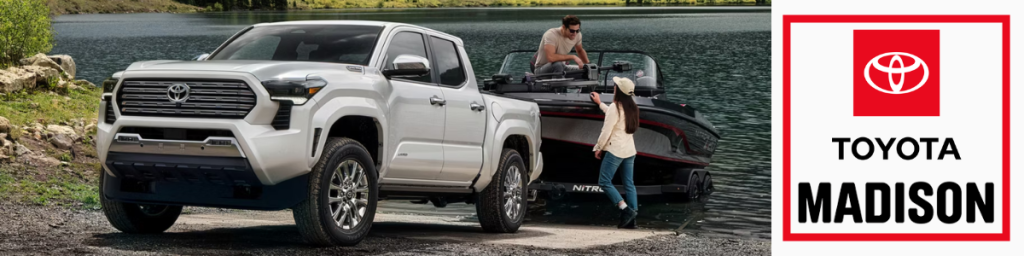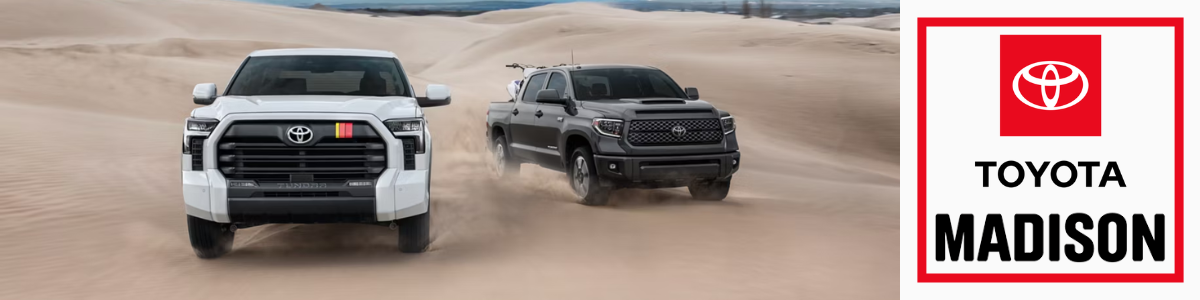


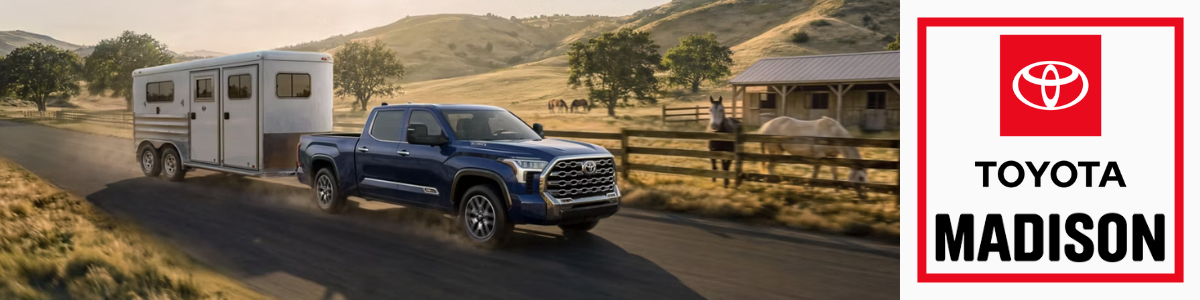
One Truck, Ten Tow Ratings, How Every 2026 Tundra Stacks Up Ask five Tundra owners how much their truck can tow, and you'll get five different answers, and every one of them might be right. The 2026 Toyota Tundra has a towing capacity of 8,300 to 12,000 pounds, and the exact rating depends on the trim, cab, bed, drivetrain, and engine you choose. Toyota's top 2026 rating of 12,000 pounds belongs to the SR5 Double Cab with rear-wheel drive and the 6.5-foot bed. Hybrid i-FORCE MAX trims top out at 11,450 pounds on the Limited, while the Capstone is rated at 10,290 pounds. Every 2026 Tundra ships with a tow hitch and 7-pin/4-pin connector, and every trim above SR adds an Integrated Trailer Brake Controller. See the 2026 Tundra Toyota's overview walks through the i-FORCE and i-FORCE MAX powertrains, the cab and bed combinations, and the trim ladder every rating below is built on. Shop Tundra inventory Three Engine Tunes, Three Different Ceilings All 2026 Tundras share a 3.4-liter twin-turbo V6 and a 10-speed automatic, but Toyota tunes that engine three ways. In the SR, it makes 348 horsepower and 405 lb-ft of torque, and every SR is rated at 8,300 pounds, no matter how you build it. Move up to the SR5 and the same V6 makes 389 horsepower and 479 lb-ft, which opens the door to the full 12,000-pound rating. The i-FORCE MAX hybrid adds an electric motor, delivering 437 horsepower and 583 lb-ft of torque. Extra torque feels great on a boat ramp, but hybrid hardware adds weight, so hybrid tow ratings land a little below the best gas figures. How Toyota Tundra Towing Capacity Shifts by Cab and Bed This part trips up plenty of shoppers. Toyota Tundra towing capacity is a range, not a single number, because a lighter truck can tow more. On the SR5, the Double Cab with RWD and the 6.5-foot bed hits 12,000 pounds. Add 4WD to that same truck, and you're at 11,200. Switch to a CrewMax with the 6.5-foot bed and 4WD, and the rating drops to 11,010, nearly 1,000 pounds below the headline figure on the very same trim. Bed length matters too. Only the Double Cab SR and SR5 models offer the 8.1-foot bed, and the SR5 with 4WD carries an 11,090-pound rating. TRD Pro and Capstone come only as a CrewMax with the 5.5-foot bed. Where the Hybrid Trims Land The Limited i-FORCE MAX is the hybrid to pick if towing tops your list. With RWD and the 5.5-foot bed on a CrewMax, it's rated at 11,450 pounds, the best of any hybrid Tundra, and it's the only hybrid trim offered with RWD at all. Platinum and 1794 Edition hybrids sit between 10,960 and 10,990 pounds, since both come with 4WD and carry more equipment. Off-road suspension and FOX shocks bring the TRD Pro in at 11,130 pounds, and the Capstone, with 22-inch wheels and power running boards, is the lowest in the lineup at 10,290 pounds. Payload Is the Number People Forget Towing capacity gets the attention, but payload decides whether the math works. A common rule of thumb puts tongue weight at roughly a tenth of a trailer's loaded weight, and your owner's manual gives the exact range. Toyota's 2026 SR Double Cab with RWD and the 8.1-foot bed leads the lineup at 1,850 pounds of payload, while the Capstone drops to 1,420. Hook a 9,000-pound trailer to a Capstone, and tongue weight alone could eat 900 pounds of that before anyone climbs in. Tow Gear That Comes Standard for 2026 Toyota made two useful changes this year. A tow hitch receiver and 7-pin/4-pin connector are now standard on every 2026 Tundra, including the SR, and every trim gets the 32.2-gallon fuel tank. Step up to SR5 or higher to add the Integrated Trailer Brake Controller, TOW/HAUL driving modes, and Blind Spot Monitor with Trailer Merge Warning. Platinum and 1794 Edition include the Trailer Backup Guide with Straight Path Assist, and a Tow Tech Package with a wireless trailer camera is available on the TRD Pro. 2026 Toyota Tundra Towing and Payload by Trim Trim Powertrain Horsepower / Torque Cab and Bed Options Max Towing (lbs) Payload (lbs) SR i-FORCE 3.4L Twin-Turbo V6 348 hp / 405 lb-ft Double Cab 6.5 or 8.1 ft; CrewMax 5.5 ft 8,300 1,710 to 1,850 SR5 i-FORCE 3.4L Twin-Turbo V6 389 hp / 479 lb-ft Double Cab 6.5 or 8.1 ft; CrewMax 5.5 or 6.5 ft 11,010 to 12,000 1,695 to 1,830 Limited i-FORCE 3.4L Twin-Turbo V6 389 hp / 479 lb-ft CrewMax 5.5 or 6.5 ft 10,970 to 11,350 1,635 to 1,685 Platinum i-FORCE 3.4L Twin-Turbo V6 389 hp / 479 lb-ft CrewMax 5.5 or 6.5 ft 10,870 to 11,310 1,545 to 1,575 1794 Edition i-FORCE 3.4L Twin-Turbo V6 389 hp / 479 lb-ft CrewMax 5.5 or 6.5 ft 11,050 to 11,310 1,545 to 1,575 Limited i-FORCE MAX i-FORCE MAX 3.4L Twin-Turbo V6 Hybrid 437 hp / 583 lb-ft CrewMax 5.5 or 6.5 ft 11,060 to 11,450 1,575 to 1,655 Platinum i-FORCE MAX i-FORCE MAX 3.4L Twin-Turbo V6 Hybrid 437 hp / 583 lb-ft CrewMax 5.5 or 6.5 ft (4WD) 10,960 to 10,990 1,510 to 1,575 1794 Edition i-FORCE MAX i-FORCE MAX 3.4L Twin-Turbo V6 Hybrid 437 hp / 583 lb-ft CrewMax 5.5 or 6.5 ft (4WD) 10,960 to 10,990 1,510 to 1,575 TRD Pro i-FORCE MAX 3.4L Twin-Turbo V6 Hybrid 437 hp / 583 lb-ft CrewMax 5.5 ft (4WD) 11,130 1,580 Capstone i-FORCE MAX 3.4L Twin-Turbo V6 Hybrid 437 hp / 583 lb-ft CrewMax 5.5 ft (4WD) 10,290 1,420 Ratings are Toyota's published 2026 maximums and vary within each trim by cab, bed, and drivetrain. Always confirm the door jamb label on the exact truck before towing. Matching Your Trailer to the Right Tundra If you tow near the top end, the SR5 Double Cab with RWD and the 6.5-foot bed is the clear pick, and it's also the least expensive way to reach 12,000 pounds. Most people won't need that much. Every CrewMax with 4WD lands between 10,290 and 11,350 pounds, depending on trim, and that covers the bass boats, pontoons, and campers you see on the roads around here, with back seat room a Double Cab can't match. Weigh what you actually pull, loaded, add a cushion, then pick the trim you'll enjoy the other 350 days of the year. Find Your Tundra Tow Rig at Toyota of Madison Madison sits right on the Ohio River, so we talk trailers all day with drivers from Scottsburg, North Vernon, Seymour, and up from Louisville. A tow chart is one thing. Standing next to a Double Cab and a CrewMax, checking the doorjamb payload label, and feeling how the i-FORCE MAX pulls during a test drive is another. Our sales team will walk you through the exact build in front of you, no pressure and no guesswork, and our Toyota-trained technicians can keep up with the extra wear towing puts on brakes and fluids. Tell us what you're pulling, and we'll find the Tundra that handles it with room to spare. Toyota Tundra Towing Questions What is the maximum towing capacity of the 2026 Toyota Tundra? The 2026 Toyota Tundra tows up to 12,000 pounds when properly equipped. That rating belongs to the SR5 Double Cab with rear-wheel drive and the 6.5-foot bed. The SR is rated at 8,300 pounds, and every other trim falls between 10,290 and 12,000 pounds, depending on configuration. How much can the 2026 Tundra hybrid tow? The i-FORCE MAX hybrid trims range from 10,290 pounds on the Capstone to 11,450 pounds on the Limited i-FORCE MAX with rear-wheel drive and the 5.5-foot bed. The TRD Pro is rated at 11,130 pounds, and the Platinum and 1794 Edition hybrids fall between 10,960 and 10,990 pounds. Does the 2026 Tundra SR come with a tow hitch? Yes. For 2026, a tow hitch receiver and 7-pin/4-pin connector are standard on every Tundra, including the SR. The SR does not include the Integrated Trailer Brake Controller or TOW/HAUL driving modes, which start on the SR5. Which Tundra has the highest payload capacity? The 2026 Tundra SR Double Cab with rear-wheel drive and the 8.1-foot bed carries the highest payload rating at 1,850 pounds. Higher trims carry more equipment, so payload drops to 1,420 pounds on the Capstone. Tell Us What You're Pulling Bring the trailer weight and we will match it to a build with room to spare, then check the door jamb label together so there is no guesswork. Shop Tundra inventory Schedule a test drive
Toyota SUV Lineup: Every Model Compared
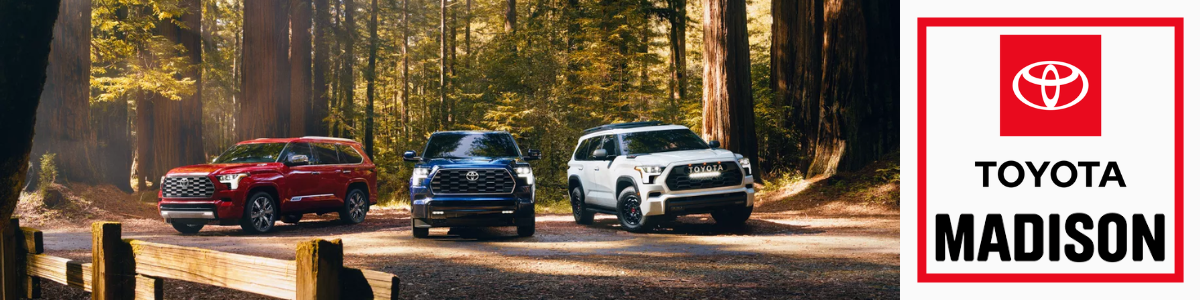
Corolla Cross to Sequoia, a Trim-by-Trim Look at Toyota's SUVs Toyota's 2026 SUV lineup covers eleven nameplates, and the names alone can make your head spin. Is a bZ Woodland the same thing as a RAV4 Woodland? Why are there two Highlanders? We sorted the whole lineup by size and purpose so you can skip the guesswork and zero in on the ones that fit your life. Every 2026 RAV4 is now a hybrid or plug-in hybrid, and the Plug-in Hybrid makes 324 horsepower. Three SUVs in the lineup run on battery power alone, and the bZ Woodland leads that group with 375 horsepower. Families who need a third row can pick from the Highlander, Grand Highlander, Sequoia, or a 4Runner with the available third row. How Toyota SUV Models Stack Up by Size Think of the lineup as a ladder. Small, city-friendly crossovers sit on the bottom rungs, two-row family haulers fill the middle, and three-row and body-on-frame rigs sit at the top. Every Toyota SUV in this guide is a 2026 model year. Toyota updates the lineup from year to year, so check the window sticker on any newer unit before you compare figures. Corolla Cross Keeps Costs Down Corolla Cross is the friendliest Toyota SUV on a budget, and it slips into tight parking spots with ease. Gas versions use a 169-horsepower 2.0L four-cylinder with front- or all-wheel drive. Step up to the Corolla Cross Hybrid, and you get 196 combined horsepower, standard all-wheel drive, and a manufacturer-estimated 42 mpg combined. C-HR Puts Electric Fun in a Small Package With its sloped, coupe-like roofline, the C-HR has the sportiest shape of Toyota's three electric SUVs. Both of its trims get standard all-wheel drive and 338 horsepower. bZ and bZ Woodland Bring Two Electric Flavors Think of the bZ as the practical member of Toyota's electric lineup. It comes with front- or all-wheel drive, and dual-motor versions make 338 horsepower. Weekend gravel-road trips call for the bZ Woodland, which adds a tougher look, standard all-wheel drive, and 375 horsepower, the most of Toyota's three electric SUVs. RAV4 Goes All Hybrid for 2026 The RAV4 got a full redesign for 2026, and Toyota dropped the gas-only engine. Hybrid models make 226 horsepower with front-wheel drive or 236 with all-wheel drive across six trims, from the LE up to the Limited. If you want more punch, the RAV4 Plug-in Hybrid puts out 324 combined horsepower with all-wheel drive on all four of its trims, including the first-ever RAV4 GR SPORT. Crown Signia Blends Style and Hybrid Power Sitting in a sweet spot between the RAV4 and the three-row crowd, the Crown Signia is a sleek two-row hybrid with 240 horsepower and standard all-wheel drive. It comes in XLE and Limited trims. Highlander Seats the Whole Crew Shoppers often mix up the two Highlanders. The regular Highlander seats seven or eight and comes with all-wheel drive on every 2026 trim. You can pick a 265-horsepower turbocharged four-cylinder or a 243-horsepower hybrid. Grand Highlander Makes Room in Row Three Grand Highlander is the roomier sibling, with an adult-sized third row and up to 97.5 cubic feet of cargo room with the rear seats folded. It offers three powertrains: a turbocharged gas engine, a hybrid, and the 362-horsepower Hybrid MAX. 4Runner Stays Ready for the Trail The 2026 4Runner rides on a body-on-frame chassis and comes in nine grades, from the SR5 up to the TRD Pro and Trailhunter. Its standard turbo engine makes up to 278 horsepower, and the i-FORCE MAX hybrid bumps that to as much as 326 horsepower and 465 lb-ft of torque. Families who need seven seats can add a third row on the SR5 or on the Limited with the i-FORCE engine. Land Cruiser Keeps It Simple Land Cruiser also uses body-on-frame construction and comes in two trims: the retro-flavored 1958 and the Land Cruiser grade. Both use the 326-horsepower i-FORCE MAX hybrid and full-time four-wheel drive, and both seat five. Sequoia Brings the Most Muscle Sitting at the top of the ladder is the Sequoia. Every trim uses a twin-turbo V6 i-FORCE MAX hybrid rated at 437 horsepower and 583 lb-ft of torque, the biggest numbers in the lineup. A second-row bench lets it carry eight people, or you can go with captain's chairs and seat seven. SR5 and Limited models offer rear- or four-wheel drive, and the four higher trims come with four-wheel drive. Matching the Right Toyota SUV to Your Week Start with how many seats you fill on a normal day. A Corolla Cross, RAV4, or Crown Signia suits most commuters and couples. Got a growing crew? The Grand Highlander gives you real room in all three rows. Towing a camper or chasing backroads calls for a 4Runner, Land Cruiser, or Sequoia. If you can charge at home, an electric model could keep you away from the gas pump. 2026 Toyota SUV Trims Compared Side by Side Trim Powertrain Net Horsepower Drivetrain 2026 Toyota Corolla Cross, Seats 5 L 2.0L 4-cylinder gas 169 FWD or AWD LE 2.0L 4-cylinder gas 169 FWD or AWD XLE 2.0L 4-cylinder gas 169 FWD or AWD Hybrid S 2.0L hybrid 196 AWD Hybrid SE 2.0L hybrid 196 AWD Hybrid XSE 2.0L hybrid 196 AWD 2026 Toyota C-HR, Seats 5 SE Dual-motor electric 338 AWD XSE Dual-motor electric 338 AWD 2026 Toyota bZ and bZ Woodland, Seats 5 bZ XLE FWD Single-motor electric, smaller battery Not published* FWD bZ XLE FWD Plus Single-motor electric, larger battery 221 FWD bZ XLE AWD Dual-motor electric, larger battery 338 AWD bZ Limited FWD Single-motor electric, larger battery 221 FWD bZ Limited AWD Dual-motor electric, larger battery 338 AWD bZ Woodland Dual-motor electric 375 AWD bZ Woodland Premium Dual-motor electric 375 AWD 2026 Toyota RAV4 and RAV4 Plug-in Hybrid, Seats 5 LE 2.5L hybrid 226 FWD / 236 AWD FWD or AWD SE 2.5L hybrid 226 FWD / 236 AWD FWD or AWD XLE Premium 2.5L hybrid 226 FWD / 236 AWD FWD or AWD Woodland 2.5L hybrid 236 AWD XSE 2.5L hybrid 236 AWD Limited 2.5L hybrid 236 AWD Plug-in Hybrid SE 2.5L plug-in hybrid 324 AWD Plug-in Hybrid Woodland 2.5L plug-in hybrid 324 AWD Plug-in Hybrid XSE 2.5L plug-in hybrid 324 AWD Plug-in Hybrid GR SPORT 2.5L plug-in hybrid 324 AWD 2026 Toyota Crown Signia, Seats 5 XLE 2.5L hybrid 240 AWD Limited 2.5L hybrid 240 AWD 2026 Toyota Highlander, Seats 7 or 8, depending on trim XLE 2.4L turbo 4-cylinder gas 265 AWD XSE 2.4L turbo 4-cylinder gas 265 AWD Limited 2.4L turbo 4-cylinder gas 265 AWD Platinum 2.4L turbo 4-cylinder gas 265 AWD Hybrid XLE 2.5L hybrid 243 AWD Hybrid Limited 2.5L hybrid 243 AWD Hybrid Platinum 2.5L hybrid 243 AWD 2026 Toyota Grand Highlander, Seats 7 or 8, depending on trim LE 2.4L turbo 4-cylinder gas 265 FWD or AWD XLE 2.4L turbo 4-cylinder gas 265 FWD or AWD Limited 2.4L turbo 4-cylinder gas 265 FWD or AWD Platinum 2.4L turbo 4-cylinder gas 265 AWD Hybrid LE 2.5L hybrid 245 AWD available Hybrid XLE 2.5L hybrid 245 AWD available Hybrid Limited 2.5L hybrid 245 AWD Hybrid Nightshade 2.5L hybrid 245 AWD Hybrid MAX Limited 2.4L turbo Hybrid MAX 362 Full-time AWD Hybrid MAX Platinum 2.4L turbo Hybrid MAX 362 Full-time AWD 2026 Toyota 4Runner, Seats 5, or 7 with the available third row on SR5 and Limited i-FORCE SR5 2.4L turbo i-FORCE Up to 278 RWD or 4WD TRD Sport 2.4L turbo i-FORCE Up to 278 RWD or 4WD TRD Sport Premium 2.4L turbo i-FORCE Up to 278 RWD or 4WD TRD Off-Road i-FORCE or i-FORCE MAX hybrid Up to 278 / up to 326 4WD TRD Off-Road Premium i-FORCE or i-FORCE MAX hybrid Up to 278 / up to 326 4WD Limited i-FORCE or i-FORCE MAX hybrid Up to 278 / up to 326 RWD or 4WD Platinum 2.4L turbo i-FORCE MAX hybrid Up to 326 Full-time 4WD TRD Pro 2.4L turbo i-FORCE MAX hybrid Up to 326 4WD Trailhunter 2.4L turbo i-FORCE MAX hybrid Up to 326 4WD 2026 Toyota Land Cruiser, Seats 5 1958 2.4L turbo i-FORCE MAX hybrid 326 Full-time 4WD Land Cruiser 2.4L turbo i-FORCE MAX hybrid 326 Full-time 4WD 2026 Toyota Sequoia, Seats 7 or 8, depending on second-row setup SR5 Twin-turbo V6 i-FORCE MAX hybrid 437 RWD or 4WD Limited Twin-turbo V6 i-FORCE MAX hybrid 437 RWD or 4WD Platinum Twin-turbo V6 i-FORCE MAX hybrid 437 4WD TRD Pro Twin-turbo V6 i-FORCE MAX hybrid 437 4WD 1794 Edition Twin-turbo V6 i-FORCE MAX hybrid 437 4WD Capstone Twin-turbo V6 i-FORCE MAX hybrid 437 4WD Horsepower shown is net combined system output for hybrid and electric models. *Toyota hasn't published a horsepower figure for the bZ XLE FWD with the smaller battery. Specs reflect the 2026 model year as published by Toyota and can vary for other model years. Watch Toyota's 2026 SUV Lineup Toyota's own walkarounds for every model above. Each one opens on YouTube. 2026 Toyota Corolla Cross Overview | Toyota 2026 Toyota C-HR Reveal: Electrify Your Drive | Toyota 2026 Toyota bZ Reveal: Redefine Electric Driving | Toyota 2026 Toyota RAV4 Reveal: Versatility for Every Adventure | Toyota 2026 Toyota Crown Signia Overview | Toyota 2026 Toyota Highlander Overview | Toyota 2026 Toyota Grand Highlander Overview | Toyota 2026 Toyota 4Runner Overview | Toyota 2026 Toyota Land Cruiser Overview Video | Toyota 2026 Toyota Sequoia Overview Video | Toyota Why Buy Your Next Toyota SUV at Toyota of Madison Spec sheets only get you so far, and that's where we come in. At Toyota of Madison, we keep a wide range of new Toyota SUVs on our lot, so you can compare trims back-to-back and take a few out for a test drive. We won't rush you, and we'll answer your questions honestly, whether you're weighing a RAV4 Hybrid against the Plug-in Hybrid or choosing between gas and hybrid power. Our finance specialists work with trusted lenders to find a plan that fits your budget. As part of the Gates Auto Family, we care about relationships that last for years. Stop by and find the SUV that fits the way you live. Frequently Asked Questions Which Toyota SUV seats the most people? The Highlander, Grand Highlander, and Sequoia can all seat up to eight with a second-row bench. The 4Runner can seat seven when you add the available third row on the SR5 or Limited with the i-FORCE engine. Does Toyota sell an all-electric SUV? Yes. The 2026 lineup includes three battery-electric SUVs: the bZ, bZ Woodland, and C-HR. The bZ Woodland is the most powerful of the three with 375 horsepower. Is every 2026 RAV4 a hybrid? Yes. Every 2026 RAV4 uses either the hybrid or the plug-in hybrid powertrain, so the gas-only version is gone for this model year. Which Toyota SUVs work best off the pavement? The 4Runner and Land Cruiser both use body-on-frame construction. The 4Runner TRD Pro and Trailhunter come with a Stabilizer Disconnect Mechanism for extra wheel travel on rough trails, and every Land Cruiser has full-time four-wheel drive with locking center and rear differentials.