

Blog

Toyota Tundra Towing Capacity by Configuration

Toyota-Tundra-Towing-Capacity-by-Configuration

One Truck, Ten Tow Ratings, How Every 2026 Tundra Stacks Up

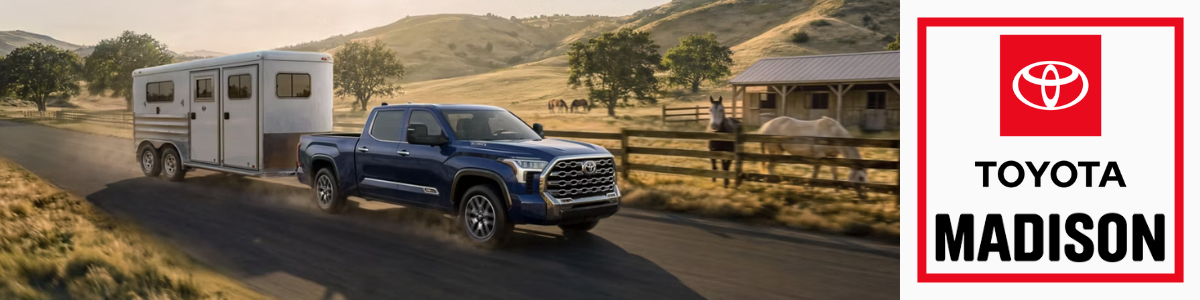
Ask five Tundra owners how much their truck can tow, and you'll get five different answers, and every one of them might be right. The 2026 Toyota Tundra has a towing capacity of 8,300 to 12,000 pounds, and the exact rating depends on the trim, cab, bed, drivetrain, and engine you choose.

  • Toyota's top 2026 rating of 12,000 pounds belongs to the SR5 Double Cab with rear-wheel drive and the 6.5-foot bed.
  • Hybrid i-FORCE MAX trims top out at 11,450 pounds on the Limited, while the Capstone is rated at 10,290 pounds.
  • Every 2026 Tundra ships with a tow hitch and 7-pin/4-pin connector, and every trim above SR adds an Integrated Trailer Brake Controller.

See the 2026 Tundra

Toyota's overview walks through the i-FORCE and i-FORCE MAX powertrains, the cab and bed combinations, and the trim ladder every rating below is built on.

Shop Tundra inventory

Three Engine Tunes, Three Different Ceilings

All 2026 Tundras share a 3.4-liter twin-turbo V6 and a 10-speed automatic, but Toyota tunes that engine three ways. In the SR, it makes 348 horsepower and 405 lb-ft of torque, and every SR is rated at 8,300 pounds, no matter how you build it. Move up to the SR5 and the same V6 makes 389 horsepower and 479 lb-ft, which opens the door to the full 12,000-pound rating. The i-FORCE MAX hybrid adds an electric motor, delivering 437 horsepower and 583 lb-ft of torque. Extra torque feels great on a boat ramp, but hybrid hardware adds weight, so hybrid tow ratings land a little below the best gas figures.

How Toyota Tundra Towing Capacity Shifts by Cab and Bed

This part trips up plenty of shoppers. Toyota Tundra towing capacity is a range, not a single number, because a lighter truck can tow more. On the SR5, the Double Cab with RWD and the 6.5-foot bed hits 12,000 pounds. Add 4WD to that same truck, and you're at 11,200. Switch to a CrewMax with the 6.5-foot bed and 4WD, and the rating drops to 11,010, nearly 1,000 pounds below the headline figure on the very same trim.

Bed length matters too. Only the Double Cab SR and SR5 models offer the 8.1-foot bed, and the SR5 with 4WD carries an 11,090-pound rating. TRD Pro and Capstone come only as a CrewMax with the 5.5-foot bed.
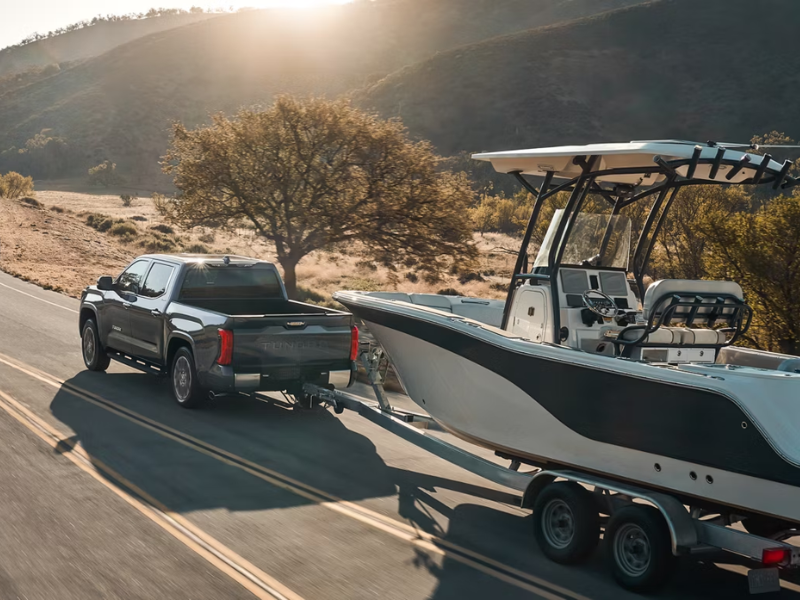
Toyota-Tundra-Towing-Capacity-by-Configuration-Towing-Boat

Where the Hybrid Trims Land

The Limited i-FORCE MAX is the hybrid to pick if towing tops your list. With RWD and the 5.5-foot bed on a CrewMax, it's rated at 11,450 pounds, the best of any hybrid Tundra, and it's the only hybrid trim offered with RWD at all. Platinum and 1794 Edition hybrids sit between 10,960 and 10,990 pounds, since both come with 4WD and carry more equipment. Off-road suspension and FOX shocks bring the TRD Pro in at 11,130 pounds, and the Capstone, with 22-inch wheels and power running boards, is the lowest in the lineup at 10,290 pounds.

Payload Is the Number People Forget

Towing capacity gets the attention, but payload decides whether the math works. A common rule of thumb puts tongue weight at roughly a tenth of a trailer's loaded weight, and your owner's manual gives the exact range. Toyota's 2026 SR Double Cab with RWD and the 8.1-foot bed leads the lineup at 1,850 pounds of payload, while the Capstone drops to 1,420. Hook a 9,000-pound trailer to a Capstone, and tongue weight alone could eat 900 pounds of that before anyone climbs in.

Tow Gear That Comes Standard for 2026

Toyota made two useful changes this year. A tow hitch receiver and 7-pin/4-pin connector are now standard on every 2026 Tundra, including the SR, and every trim gets the 32.2-gallon fuel tank. Step up to SR5 or higher to add the Integrated Trailer Brake Controller, TOW/HAUL driving modes, and Blind Spot Monitor with Trailer Merge Warning. Platinum and 1794 Edition include the Trailer Backup Guide with Straight Path Assist, and a Tow Tech Package with a wireless trailer camera is available on the TRD Pro.

2026 Toyota Tundra Towing and Payload by Trim

Trim Powertrain Horsepower / Torque Cab and Bed Options Max Towing (lbs) Payload (lbs)
SR i-FORCE 3.4L Twin-Turbo V6 348 hp / 405 lb-ft Double Cab 6.5 or 8.1 ft; CrewMax 5.5 ft 8,300 1,710 to 1,850
SR5 i-FORCE 3.4L Twin-Turbo V6 389 hp / 479 lb-ft Double Cab 6.5 or 8.1 ft; CrewMax 5.5 or 6.5 ft 11,010 to 12,000 1,695 to 1,830
Limited i-FORCE 3.4L Twin-Turbo V6 389 hp / 479 lb-ft CrewMax 5.5 or 6.5 ft 10,970 to 11,350 1,635 to 1,685
Platinum i-FORCE 3.4L Twin-Turbo V6 389 hp / 479 lb-ft CrewMax 5.5 or 6.5 ft 10,870 to 11,310 1,545 to 1,575
1794 Edition i-FORCE 3.4L Twin-Turbo V6 389 hp / 479 lb-ft CrewMax 5.5 or 6.5 ft 11,050 to 11,310 1,545 to 1,575
Limited i-FORCE MAX i-FORCE MAX 3.4L Twin-Turbo V6 Hybrid 437 hp / 583 lb-ft CrewMax 5.5 or 6.5 ft 11,060 to 11,450 1,575 to 1,655
Platinum i-FORCE MAX i-FORCE MAX 3.4L Twin-Turbo V6 Hybrid 437 hp / 583 lb-ft CrewMax 5.5 or 6.5 ft (4WD) 10,960 to 10,990 1,510 to 1,575
1794 Edition i-FORCE MAX i-FORCE MAX 3.4L Twin-Turbo V6 Hybrid 437 hp / 583 lb-ft CrewMax 5.5 or 6.5 ft (4WD) 10,960 to 10,990 1,510 to 1,575
TRD Pro i-FORCE MAX 3.4L Twin-Turbo V6 Hybrid 437 hp / 583 lb-ft CrewMax 5.5 ft (4WD) 11,130 1,580
Capstone i-FORCE MAX 3.4L Twin-Turbo V6 Hybrid 437 hp / 583 lb-ft CrewMax 5.5 ft (4WD) 10,290 1,420

Ratings are Toyota's published 2026 maximums and vary within each trim by cab, bed, and drivetrain. Always confirm the door jamb label on the exact truck before towing.

Matching Your Trailer to the Right Tundra

If you tow near the top end, the SR5 Double Cab with RWD and the 6.5-foot bed is the clear pick, and it's also the least expensive way to reach 12,000 pounds. Most people won't need that much. Every CrewMax with 4WD lands between 10,290 and 11,350 pounds, depending on trim, and that covers the bass boats, pontoons, and campers you see on the roads around here, with back seat room a Double Cab can't match. Weigh what you actually pull, loaded, add a cushion, then pick the trim you'll enjoy the other 350 days of the year.

Find Your Tundra Tow Rig at Toyota of Madison

Madison sits right on the Ohio River, so we talk trailers all day with drivers from Scottsburg, North Vernon, Seymour, and up from Louisville. A tow chart is one thing. Standing next to a Double Cab and a CrewMax, checking the doorjamb payload label, and feeling how the i-FORCE MAX pulls during a test drive is another. Our sales team will walk you through the exact build in front of you, no pressure and no guesswork, and our Toyota-trained technicians can keep up with the extra wear towing puts on brakes and fluids. Tell us what you're pulling, and we'll find the Tundra that handles it with room to spare.

Toyota Tundra Towing Questions

What is the maximum towing capacity of the 2026 Toyota Tundra?

The 2026 Toyota Tundra tows up to 12,000 pounds when properly equipped. That rating belongs to the SR5 Double Cab with rear-wheel drive and the 6.5-foot bed. The SR is rated at 8,300 pounds, and every other trim falls between 10,290 and 12,000 pounds, depending on configuration.

How much can the 2026 Tundra hybrid tow?

The i-FORCE MAX hybrid trims range from 10,290 pounds on the Capstone to 11,450 pounds on the Limited i-FORCE MAX with rear-wheel drive and the 5.5-foot bed. The TRD Pro is rated at 11,130 pounds, and the Platinum and 1794 Edition hybrids fall between 10,960 and 10,990 pounds.

Does the 2026 Tundra SR come with a tow hitch?

Yes. For 2026, a tow hitch receiver and 7-pin/4-pin connector are standard on every Tundra, including the SR. The SR does not include the Integrated Trailer Brake Controller or TOW/HAUL driving modes, which start on the SR5.

Which Tundra has the highest payload capacity?

The 2026 Tundra SR Double Cab with rear-wheel drive and the 8.1-foot bed carries the highest payload rating at 1,850 pounds. Higher trims carry more equipment, so payload drops to 1,420 pounds on the Capstone.

Tell Us What You're Pulling

Bring the trailer weight and we will match it to a build with room to spare, then check the door jamb label together so there is no guesswork.
Recommended Posts

Built-to-Pull-Toyota-Tacoma-Towing-Capacity-by-Trim-&-Configuration

Built to Pull: Toyota Tacoma Towing Capacity by Trim & Configuration

What a Tacoma Can Pull, Trim by Trim Backing a loaded trailer down a boat ramp is where a spec sheet gets real. One number on your door jamb decides how that morning goes. And across the 2026 Tacoma lineup, that number varies by 3,000 pounds. Gas-powered XtraCab models carry the highest rating in the lineup at 6,500 pounds. Gas Double Cab trucks pull 6,400 pounds, while a base SR with the automatic stops at 3,500 pounds. Every i-FORCE MAX hybrid tops out between 5,950 and 6,000 pounds because of the weight it carries. Two Engines, Two Sets of Numbers Toyota builds the 2026 Tacoma around a 2.4-liter turbocharged four-cylinder. It gets tuned three ways. The base SR pairs with an eight-speed automatic, producing 228 horsepower and 243 lb-ft of torque. Most trims above the SR run the same block at 278 horsepower and 317 lb-ft of torque. Want the six-speed manual? It shows up on 4x4 Double Cab builds and makes 270 horsepower and 310 lb-ft of torque. The i-FORCE MAX adds an electric motor to that turbo four. Output climbs to 326 horsepower and 465 lb-ft, and the Trailhunter is rated at 323 horsepower. Torque hits the instant you touch the pedal. You notice that pulling a wet boat up a steep ramp. How Toyota Tacoma Towing Capacity Breaks Down by Trim Toyota Tacoma towing capacity runs from 3,500 to 6,500 pounds. Cab style matters more than badge here. Gas XtraCab trucks, meaning SR5 and TRD PreRunner, hit the 6,500-pound ceiling. Add the back doors and gas Double Cab models settle at 6,400 pounds. That 100-pound gap rarely changes a shopping list. It does count if your trailer already sits near the limit. The base SR is the odd one out. Toyota lists it at 3,500 pounds in every cab and drivetrain it offers, which puts a hard ceiling on what the entry truck will pull. Step up one rung to the SR5, and the rating nearly doubles. Every figure below assumes a properly equipped truck and follows SAE J2807 test methods. 2026 Tacoma Tow Ratings by Trim and Configuration Trim and Powertrain Cab and Drive Max Towing (lbs.) Max Tongue Weight (lbs.) Trailer Brake Controller SR (i-FORCE) XtraCab or Double Cab, 4x2 or 4x4 3,500 640 to 650 Not offered SR5 (i-FORCE) XtraCab, 6-ft. bed 6,500 650 Package SR5 (i-FORCE) Double Cab, 4x2 or 4x4 6,400 640 Package TRD PreRunner (i-FORCE) XtraCab 4x2, 6-ft. bed 6,500 650 Package TRD Sport (i-FORCE) Double Cab, 4x2 or 4x4 6,400 640 Package TRD Off-Road (i-FORCE) Double Cab 4x4 6,400 640 Package Limited (i-FORCE) Double Cab 4x4 6,400 640 Standard TRD Sport (i-FORCE MAX) Double Cab 4x4 5,950 to 6,000 595 to 600 Package TRD Off-Road (i-FORCE MAX) Double Cab 4x4 5,950 to 6,000 595 to 600 Package Limited (i-FORCE MAX) Double Cab 4x4 5,950 to 6,000 595 to 600 Standard Trailhunter (i-FORCE MAX) Double Cab 4x4 5,950 to 6,000 595 to 600 Standard TRD Pro (i-FORCE MAX) Double Cab 4x4 5,950 to 6,000 595 to 600 Standard Ratings are Toyota figures for properly equipped trucks tested to SAE J2807. Confirm the numbers on your own door jamb sticker before you hitch up. Why the Hybrid Numbers Land Lower Most shoppers expect the strongest engine to pull the most. The 6,000-pound hybrid ceiling surprises them. Battery and motor hardware push curb weight to between 5,030 and 5,410 pounds. That mass eats into the gross combined rating. You trade about 400 pounds of trailer for instant low-end grunt, a 2400W bed outlet, and standard Tow/Haul mode. Tongue Weight Counts Against Your Payload Tongue weight usually runs 10 to 15 percent of what the trailer weighs. It presses straight down on the hitch. Gas XtraCab trucks handle 650 pounds at the ball, gas Double Cabs 640, and hybrids 595 to 600. That load comes out of the payload. Payload spans 1,230 pounds on a 4x4 XtraCab up to 1,710 pounds on some hybrid Double Cabs. Add riders, coolers, and a toolbox, and the margin shrinks fast. Trailer Tech Worth Ordering A Class-IV hitch receiver with 7-pin and 4-pin wiring is standard on SR5, TRD PreRunner, TRD Sport, and TRD Off-Road. Limited, TRD Pro, and Trailhunter add Trailer Backup Guide and a trailer blind-spot camera. Those three also include the built-in trailer brake controller. SR5, TRD PreRunner, TRD Sport, and TRD Off-Road bundle it into option packages, and the SR skips it altogether. Towing a tandem-axle trailer? Treat that controller as a must-have. Picking a Build That Matches Your Trailer Weigh your trailer loaded, with coolers, gear, and a full water tank. Then shop backward from that number. Anything heavier than 6,400 pounds points you toward a gas XtraCab, meaning an SR5 or TRD PreRunner. Trailers in the 4,000 to 5,500 range open up most of the lineup, hybrids included. Those builds still leave room for a family in the back seat. Light utility and single-axle boat trailers under 3,500 pounds fit even the base SR. Talk Tow Ratings With Us at Toyota of Madison We stock Tacomas in a mix of cabs, beds, and powertrains. Towing needs around here run from a jon boat to a loaded equipment trailer. Bring us your trailer weight, and we'll walk you out to trucks that match it. We'll open the doors and read the ratings with you. We'll also cover hitch setup, brake controller choices, and wiring before you sign anything. Our Toyota-trained techs handle the follow-up, from hitch installs to the service a hardworking truck needs. Drivers from Madison, Scottsburg, Seymour, and across the river in Louisville know we'd rather spend the extra ten minutes up front.

Two-Icons-One-Choice-2026-Toyota-Camry vs-Honda-Accord

Two Icons, One Choice: 2026 Toyota Camry vs. Honda Accord

How the 2026 Camry and Accord Match Up for Daily Drivers America's two best-selling sedans have traded punches for decades, and 2026 keeps the rivalry going strong. Toyota went all-in on hybrid power for every Camry this year, while Honda still sells a gas Accord and saves its hybrid setup for the upper trims. Both seat five, both sip fuel, and both have loyal fans who swear by their pick. So which one belongs in your driveway? Every 2026 Camry comes as a hybrid, starting at $29,300 and rated up to 51 mpg combined on the LE grade. Honda's 2026 Accord starts lower at $28,395 with a turbo gas engine, and its hybrid trims reach up to 48 mpg combined. Toyota offers all-wheel drive on every Camry trim, while the Accord stays front-wheel drive across the whole lineup. What's Under the Hood This is where the two cars split in a big way. Every 2026 Camry runs a 2.5L four-cylinder hybrid paired with an eCVT. Front-drive models make 225 horsepower combined, and the available all-wheel-drive setup bumps that to 232. You get the same hybrid no matter which Camry you choose. Honda plays it differently. Base LX and SE trims use a 1.5L turbocharged four-cylinder good for 192 horsepower and 192 lb-ft of torque, with a CVT. Want the hybrid? You'll step up to the Sport Hybrid or higher, which runs a 2.0L two-motor system rated at 204 horsepower and a strong 247 lb-ft of torque. That tradeoff sits at the heart of the 2026 Toyota Camry vs. Honda Accord question. Toyota gives you hybrid power from the jump, and Honda lets you start cheaper on gas before paying up for electrification. Fuel Economy by the Numbers Toyota's all-hybrid plan pays off at the pump. In front-drive form, the Camry LE earns an EPA-estimated 52 city, 49 highway, and 51 combined. Sportier SE, XLE, and XSE trims land around 47/45/46. Adding AWD trims those numbers a touch. Honda's gas Accord LX returns 29 city, 37 highway, and 32 combined, with the SE close behind at 28/36/31. Move to the hybrids, and the gap shrinks fast. Most Accord hybrids hit 46/41/44, and the EX-L Hybrid is the mileage champ of the bunch at 51/44/48. Camry still edges ahead on combined numbers, but a hybrid Accord is no slouch. Trim-by-Trim Breakdown Trim Powertrain Horsepower Combined MPG Starting MSRP 2026 Toyota Camry (Hybrid, FWD or AWD) LE 2.5L Hybrid 225 hp (FWD) 51 $29,300 SE 2.5L Hybrid 225 hp (FWD) 46 $31,800 Nightshade 2.5L Hybrid 225 hp (FWD) 46 $32,800 XLE 2.5L Hybrid 225 hp (FWD) 46 $34,500 XSE 2.5L Hybrid 225 hp (FWD) 46 $35,700 2026 Honda Accord (Gas or Hybrid, FWD only) LX 1.5L Turbo Gas 192 hp 32 $28,395 SE 1.5L Turbo Gas 192 hp 31 $30,695 Sport Hybrid 2.0L Hybrid 204 hp 44 $33,795 EX-L Hybrid 2.0L Hybrid 204 hp 48 $35,095 Sport-L Hybrid 2.0L Hybrid 204 hp 44 $35,495 Touring Hybrid 2.0L Hybrid 204 hp 44 $39,495 Prices exclude the $1,195 destination charge on both cars. Camry AWD adds $1,525 to any trim. Tech and Cabin Touches Both sedans load up on screens. Camry runs an 8-inch touchscreen on the LE, SE, and Nightshade, then jumps to a 12.3-inch display on the XLE and XSE. Wireless Apple CarPlay and Android Auto come standard on every trim, and so does blind spot monitoring with rear cross-traffic alert. Move up the ladder, and you can add a JBL audio system, a head-up display, and a panoramic roof. Accord answers with a 9-inch screen on the LX and SE and a 12.3-inch unit on the hybrids, plus a 10.2-inch digital gauge cluster on all trims. Honda keeps a physical volume knob, which many drivers appreciate. Up top, the Touring Hybrid piles on Google built-in, a 12-speaker Bose system, a heated steering wheel, and ventilated front seats. Worth flagging too, blind spot info is standard on the SE and up, but not on the base LX. Picking the Sedan That Fits Your Week If you want the best gas mileage for the least money, plus the option of all-wheel drive for snowy mornings, the Camry makes the easy case. Every trim is a hybrid, so you never have to choose between saving fuel and saving cash. Drivers who want a lower entry price on gas, a sportier steering feel, or a fully loaded tech flagship like the Touring will lean toward Honda. Both are dependable picks that hold their worth well, so a test drive in each is the smartest way to settle it. See the 2026 Camry at Toyota of Madison At Toyota of Madison, we make it simple to put the 2026 Camry to the test in person. Reading specs is one thing, but feeling how the hybrid pulls away from a stop and checking whether that 12.3-inch screen suits you is another. We keep a wide selection of new Camry trims on the lot, and our team is glad to walk you through each one at your own pace. Stop by when you're ready to compare them side by side, take a drive around Madison, and find the trim that fits how you actually drive.

2026-Toyota-Highlander-vs-Grand-Highlander-Two-SUVs-One-Perfect-Fit

2026 Toyota Highlander vs. Grand Highlander: Two SUVs. One Perfect Fit.

Sizing Up Toyota's Two Three-Row SUVs Toyota sells two three-row SUVs with almost the same name, and that trips up a lot of shoppers. Both share a badge, a turbocharged four-cylinder, and the same family-hauling job description. What separates them is about six inches of sheet metal and a third row that changes the math for anyone who uses it more than twice a year. The Grand Highlander stretches 201.4 inches long on a 116.1-inch wheelbase, while most Highlander grades measure 194.9 inches on a 112.2-inch wheelbase. Both SUVs share a 265-horsepower turbocharged 2.4-liter gas engine, but only the Grand Highlander offers the 362-horsepower Hybrid MAX setup. Pricing starts at $41,860 for the gas Grand Highlander LE and $45,870 for the gas Highlander XLE, both before the $1,495 destination charge. Where Those Extra Inches Actually Land Park these two next to each other, and the gap looks smaller than the spec sheet suggests. Toyota puts most of the added length behind the second row. That's exactly where families feel it. Cargo room behind the Grand Highlander's third row measures 20.6 cubic feet. Fold the second and third rows down, and it opens up to 97.5 cubic feet. Toyota lists the Highlander's max at 84.3 cubic feet with every seat folded, but hasn't published a behind-the-second-row number for 2026. Don't assume the two are close there. Width and height tell part of the story, too. Grand Highlander stands 70.1 inches tall and 78.3 inches wide, against 68.1 by 76.0 for the Highlander. That boxier shape is what third-row riders notice around their shoulders and heads. Two Engine Menus, One With an Extra Course Under the hood, things start out identical. Each SUV runs a 2.4-liter turbo four rated at 265 horsepower and 310 lb-ft of torque, paired with an eight-speed automatic. From there, the lineups split. Every 2026 Highlander gas grade arrives with all-wheel drive standard. The larger SUV begins as a front-driver on LE, XLE, and Limited. AWD adds $1,600 on those grades and comes standard on the gas Platinum. Hybrids follow a similar pattern. Highlander's 2.5-liter hybrid makes 243 combined horsepower with electronic on-demand AWD on every grade. The EPA rates it at 35 mpg combined. Step over to the Grand Highlander, and its 2.5-liter hybrid makes 245 combined horsepower, good for 34 mpg combined in AWD LE and Limited form. Then there's the powertrain Highlander can't answer. Hybrid MAX pairs a turbocharged 2.4-liter with front and rear electric motors for 362 combined horsepower and 400 lb-ft. It runs a six-speed automatic and still posts 27 mpg combined. Towing and Trailer Math Gas grades of either SUV pull 5,000 pounds with the required equipment. Pick a standard hybrid, and both fall to 3,500 pounds. Hybrid MAX climbs back to 5,000 pounds. That makes the Grand Highlander your only path to a Toyota hybrid three-row rated for the full 5,000 pounds. Anyone towing a small camper or a pair of jet skis should sit with that number for a while. Safety Tech and Screens Take Different Paths Highlander carries Toyota Safety Sense 2.5+. Grand Highlander steps up to Toyota Safety Sense 3.0. That version adds Proactive Driving Assist, which applies gentle braking and light steering to help around cyclists, walkers, and slower traffic. Blind Spot Monitor with Rear Cross-Traffic Alert is standard on every grade of both SUVs. Screens differ as well. Highlander starts with an 8-inch touchscreen and offers a 12.3-inch upgrade. The 12.3-inch display comes standard across the entire Grand Highlander lineup. 2026 Highlander and Grand Highlander Trim Comparison Chart Trim Powertrain Horsepower Drivetrain EPA MPG City/Hwy Starting MSRP 2026 TOYOTA HIGHLANDER XLE 2.4L Turbo Gas, 8-Speed Auto 265 hp / 310 lb-ft Mechanical AWD 21 / 28 $46,270 XSE 2.4L Turbo Gas, 8-Speed Auto 265 hp / 310 lb-ft Torque Vectoring AWD 21 / 28 $48,340 Limited 2.4L Turbo Gas, 8-Speed Auto 265 hp / 310 lb-ft Torque Vectoring AWD 21 / 28 $50,725 Platinum 2.4L Turbo Gas, 8-Speed Auto 265 hp / 310 lb-ft Torque Vectoring AWD 21 / 28 $53,925 Hybrid XLE 2.5L Hybrid, eCVT 243 hp combined Electronic On-Demand AWD 35 / 35 $48,020 Hybrid Limited 2.5L Hybrid, eCVT 243 hp combined Electronic On-Demand AWD 35 / 34 $52,475 Hybrid Platinum 2.5L Hybrid, eCVT 243 hp combined Electronic On-Demand AWD 35 / 34 $55,675 2026 TOYOTA GRAND HIGHLANDER LE 2.4L Turbo Gas, 8-Speed Auto 265 hp / 310 lb-ft FWD, AWD +$1,600 21 / 28 (FWD) $42,060 XLE 2.4L Turbo Gas, 8-Speed Auto 265 hp / 310 lb-ft FWD, AWD +$1,600 21 / 28 (FWD) $44,830 Limited 2.4L Turbo Gas, 8-Speed Auto 265 hp / 310 lb-ft FWD, AWD +$1,600 21 / 28 (FWD) $49,560 Platinum 2.4L Turbo Gas, 8-Speed Auto 265 hp / 310 lb-ft AWD standard 20 / 26 $55,245 Hybrid LE 2.5L Hybrid, eCVT 245 hp combined FWD or Electronic On-Demand AWD 36 / 32 $45,410 Hybrid XLE 2.5L Hybrid, eCVT 245 hp combined FWD or Electronic On-Demand AWD 37 / 34 $46,580 Hybrid Limited 2.5L Hybrid, eCVT 245 hp combined Electronic On-Demand AWD 36 / 32 $52,910 Hybrid Nightshade 2.5L Hybrid, eCVT 245 hp combined Electronic On-Demand AWD 36 / 32 $53,890 Hybrid MAX Limited 2.4L Turbo Hybrid MAX, 6-Speed Auto 362 hp / 400 lb-ft combined Full-Time Electronic AWD 26 / 27 $55,890 Hybrid MAX Platinum 2.4L Turbo Hybrid MAX, 6-Speed Auto 362 hp / 400 lb-ft combined Full-Time Electronic AWD 26 / 27 $59,975 All MSRP figures exclude the $1,495 delivery, processing, and handling charge. Highlander towing tops out at 5,000 lb on gas grades and 3,500 lb on hybrid grades. Grand Highlander towing tops out at 5,000 lb on gas and Hybrid MAX grades and 3,500 lb on standard hybrid grades. EPA estimates are for comparison only, and your mileage will vary. The Highlander That Fits Most Driveways Anyone weighing the 2026 Toyota Highlander vs. Grand Highlander is really asking one question. How often does row three carry passengers? If the answer is holiday weekends and carpool overflow, Highlander handles it, costs less on the hybrid side, and slots into a tight garage without drama. If your third row has a regular passenger, or if groceries and sports bags pile up behind it every week, the 20.6 cubic feet and the Hybrid MAX option make the Grand Highlander worth the stretch. Toyota built these two for different kinds of weeks, and both do their job well. Why Buy Your Next Highlander at Toyota of Madison Numbers on a page can only take you so far with a decision like this. We keep both the Highlander and Grand Highlander on the lot so you can climb into the third row of each, fold the seats, and load your own stroller or hockey bag before you sign anything. Our team will walk you through gas versus hybrid versus Hybrid MAX in plain terms, no jargon and no pressure. Bring the whole family and the car seats, and we'll help you sort out which one fits your week in Madison and the surrounding area.